The number itself would also be manageable, the problem is that hand in hand with the increase in population are the demands for food, but more importantly for goods and services. Mauro Balboni in Il Pianeta dei Frigoriferi puts the spotlight on how difficult it will be in the future to feed another 3 billion people, when already half of the landmass is converted to cropland and pasture. Moreover, corresponding to population growth, it is predicted that in the near future many more people will have access to goods that are considered, if not primary, important (such as the refrigerator and the cell phone), but for which there are not the raw materials to produce them sustainably.
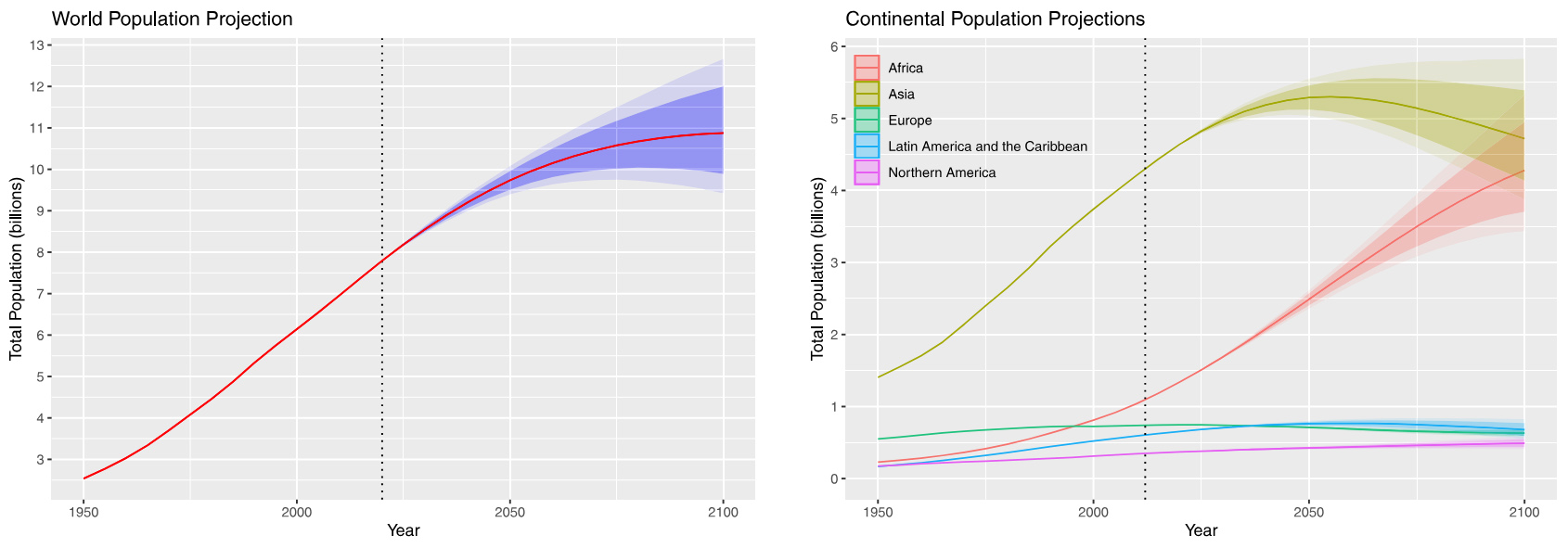
Aggregate Bayesian probabilistic population projections. (a) Left: world population projection, 2020-2100. The red line shows the historical data and the median forecast. The dark and light shaded areas show the 80% and 95% forecast ranges, respectively. (b) Right: Projections for each continent. (Probabilistic population forecasting: Short to very long-term by Adrian E. Raftery, Hana Ševčíková)
With greater demand comes greater supply
Produce produce produce. As people increase, demand increases. And where there is demand, there is supply. Regardless of individual consumption habits, it is not possible to hope to mitigate global warming and ensure a minimum level of nutrition for everyone on Earth without consuming less: projections from 2010 to 2050 predict that the demand for daily kilocalories per person will rise from 2,800 to about 3,200. At the same time, the undernourished population in 2010 numbered 800 million, with a declining trend until 2020, but this figure may change very quickly in the near future: more people are on the way, requiring more caloric intake, on a planet that is already largely compromised by resource exploitation.
To wash their consciences, wealthier countries are running for cover by trying to shift the problem from one commodity to another. If fossil fuels are the problem, is conversion to electric energy the solution? No, at least not as long as the most polluting industrial vehicles (such as trucks and cargo ships) continue to use fossil fuels. And as long as the production and disposal of the batteries needed to store the energy (produced from renewable sources hopefully) is not regulated and included in a circular system, minimising the process of rare earth extraction, then it has all been for nothing. Stopping oil extraction and drastically increasing semiconductor extraction is not a solution, no matter how much in the short run it may avoid direct CO2 input into the atmosphere. Continuing to feed new raw materials into production processes is a luxury we can no longer afford and has unsustainable environmental costs.
Similarly, converting fields from pasture to soy monocultures for “veggie” products is not an effective solution. The unsustainability of the model of food production, distribution and consumption depends not so much on individual foods (often labelled as “good” or “bad” on the basis of a single characteristic), but on the intensity of the anthropogenic input required to get those foods onto supermarket shelves around the world every day. Are there alternative models? Yes, they have been discussed in this same journal in articles such as Regenerative Agriculture – Beyond Sustainability, but they do not guarantee the yields and timelines needed by large retailers.
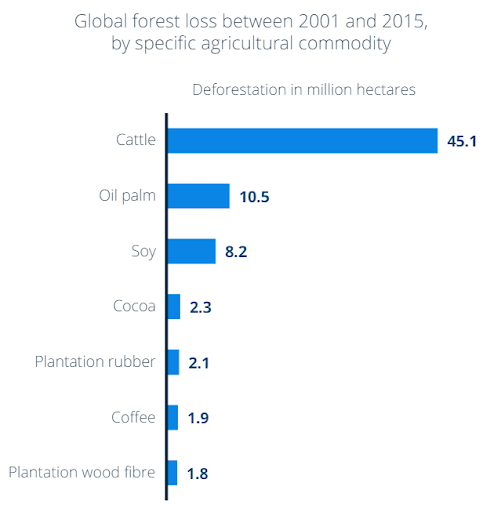
Loss of global forests, in millions of hectares, between 2001 and 2015, broken down by agricultural product (Statista, Dossier Plus “Nature-Based solutions to the biodiversity and climate crisis,” 2022)
Di chi è la responsabilità? I capricci del mercato
Il fattore economico incide quasi interamente nelle scelte di consumo. Per quanto una persona possa essere consapevole dell’impatto ambientale di alcuni prodotti rispetto ad altri, dal momento in cui le scelte sostenibili sono sconvenienti economicamente decidere di investire su di esse diventa difficile. Controintuitivamente, i prodotti ipercalorici sono quelli che costano meno: nonostante siano ricchi di zuccheri e grassi, quindi la cui produzione teoricamente ha avuto un investimento maggiore, il basso costo della manodopera e la grande distribuzione li fa arrivare sugli scaffali a prezzi molto bassi. Di conseguenza, la denutrizione e la malnutrizione vanno spesso a braccetto, specialmente in contesti economicamente svantaggiati.
Whose responsibility is it? The whims of the market
The economic factor affects consumption choices almost entirely. As much as a person may be aware of the environmental impact of some products over others, from the moment sustainable choices are economically inconvenient, deciding to invest in them becomes difficult. Counterintuitively, the high-calorie products are the ones that cost the least: despite being high in sugar and fat, so whose production theoretically had a greater investment, the low cost of labour and large-scale distribution gets them on the shelves at very low prices. As a result, undernutrition and malnutrition often go hand in hand, especially in economically disadvantaged settings.
Despite the fact that this is a social phenomenon dictated by the economic model, in more affluent circles the narrative is that those who are malnourished or suffer from nutrition-related disorders are uninformed, listless, or in short: that it is their own fault that they are in that condition. At the same time, however, those who share this narrative and have the financial means are often victims of fads and eating habits that, however healthier and more sustainable, are not globally applicable. Thus, we return to the eternal dilemma between individual, corporate and decision-making bodies’ responsibility. An in-depth discussion of this can be found in the article Tell me what you eat and I will tell you who you are, published in this same journal.
Effortless compromise? The challenge of the European Green Deal
A planet where everyone is vegan is a planet where no more animals are killed, at least until their habitat is destroyed to make way for new crop fields. Beyond the provocation, with the current model it is unlikely that all Earth’s 2050 inhabitants will be able to eat twice a day in a balanced way. So where to act to solve the problem?
Fortunately, some countries and companies are investing in finding ways to keep production high while reducing environmental impact, such as developing crops that need less fertiliser and pesticides. Leading these projects is Europe’s Green Deal, the set of investments to get EU member countries to achieve climate neutrality by 2050. On paper, this gigantic investment plan, along with others such as PNRR, should be a manifestation of a clear stance by the supranational institution to safeguard remaining resources and recover them. But to transform the economy and make it circular, mere funding of virtuous companies (although it is necessary) will hardly suffice. The scattershot distribution of investments risks increasing greenwashing, so more and more companies will want to access this funding by looking for loopholes to appear figuratively “sustainable”.
Implementation of this plan is also made difficult by communication with the public and the farms themselves. Especially in agriculture, many new regulations will come into effect. But since after the Green Revolution in the 1970s, large companies have gained more and more freedom and decision-making power, bolstered precisely by investments aimed at increasing agricultural production. Since they are now trying to change course, it is clear that these companies are unwilling to give up their status, especially if this is done through rules “imposed from above.” On the other hand, the same feeling is experienced by many citizens, who perceive their freedom in purchasing choices, so much desired and hard-earned by previous generations, as threatened.
On the other hand, from a global point of view, as far as distribution is concerned, as long as the massive export of individual commodities (such as vegetable oils, cocoa and wheat) is the only source of income for some countries there will continue to be trucks, trains and cargo ships loaded with these goods sold at very low prices in the countries where they will be processed, only to be distributed again in the countries where they are consumed.
No matter how much we try to use less water, land and resources to farm; no matter how much we try to change the transportation sector to less polluting fuels; no matter how individually people choose to change the products that end up in their shopping carts, the problem will probably still not be solved in the long run. Hoping for science is not enough: despite innovations and the ecological transition, a change in consumption is necessary. Many entertainment productions at the literary and cinematic level have imagined dystopias in which the only solution to save the world was to drastically reduce its inhabitants, so that consumption would also be reduced in tandem. The power of these fictional stories is to warn people that the real world is heading in that direction and that those proposed in the dystopias are not real solutions to the problem.
Effortless compromise is not attainable, while instead the data show that one solution may be to educate people to give up. If one hopes for a future in which everyone eats and eats better, then it is better to start eating less.

Graduated in Molecular Biology and Evolutionary Biology (UniPd), he is passionate about scientific essays.
He comes to Atmosphera Lab with the intention of putting himself to the test and writing about what has always moved his curiosity: the environment.
More articles