Atmospheralab.com
  • EcoMagazine
  • About Us
  • Contacts
  • Italiano
  • Menu Menu
  • Link to Instagram
  • Link to Facebook
  • Link to X
  • Link to LinkedIn
  • Link to Youtube
You are here: Home1 / Recycling textile fibres2 / Fashion3 / Recycling textile fibres

    Recycling textile fibres

    Fashion’s slow contribution to combating climate change

    25/07/2024

    The world of fashion in 2024

    The year 2024 marks the ninth turning point in the gruelling race toward climate neutrality: 2030 is just around the corner, and with it the ticking off of the ambitious missions subscribed to by the 193 member countries of the UN, including reducing inequality and combating climate change.

    All companies in all sectors, from extraction to processing, through production to supplies to sales, have faced the chapter of ecological transition at least once: where does the fashion world stand on this journey? Is a compromise possible between the buying frenzy due to the induced need to renew the closet, and the durability of garments supported instead by a greener vision? While it is true that it is one of the economically driving sectors, it is also true that, in order to have a closer proximity to consumers, it has had to adapt to the increasingly stringent market directions with strong trends directed toward green strategies.

    In our country, in fact, the prerequisites to support the circularity of textile fibres have been defined by Legislative Decree 116/2020, which established the obligation to separate textile waste from the remaining household waste starting in 2022. Our country appears to be quite virtuous in giving clothing a second life: already in 2020, 73 percent of Italian municipalities have introduced collection systems for the textile fraction.

    Silvia Gambi, a journalist from Prato and Europe’s largest textile district, reminds us that the apparel industry is considered among the most polluting, particularly in terms of water consumption and the release of microplastics into the environment, but it is also the one with the highest potential for circularity: “In 2020, textile consumption in Europe ranked fourth among the industries with the greatest impact on the environment and climate change.”

    To understand the scale of the industry, it is appropriate to specify its numbers: on the European continent, each individual buys an average of 26 kg of textile products and disposes of about 11 kg of them over the course of a year. These numbers are an expression of a vicious cycle consisting of overuse of resources and irrepressible production of emissions, considering the entire life cycle of a product.

    Evidence of overproduction

    In some video evidence filmed in 2021 in a British Fashion Council project, encapsulated in a documentary entitled Generation Rewear, it is estimated that with the clothing, shoes and accessories currently in existence, the next six generations could be clothed. 

    The amount of clothing produced far exceeds consumer demand and has pushed us to the gates of an endless cycle of induced need. Do we really need that new sweater? That new jacket? That new pair of jeans?

    Image Credits: @CONSCYOU

    Faced with the rapidity with which new collections are inserted and old ones eliminated, in fact, we are personally led to an adjustment, which results in a substitution of what we own for the new things put on the market. Various reasons – keeping up with the trend, maximising the pleasure of doing something for oneself, reinforcing a need for affiliation by staving off a feeling of loneliness – but a single result. The unbridled overproduction of garments and the eternal question of their disposal at the end of life. 

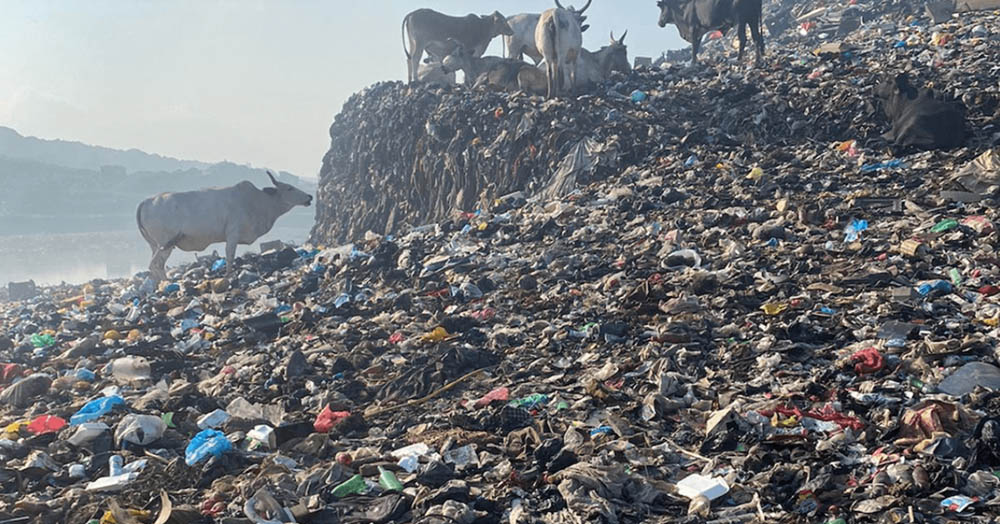
    The rapid turnover of micro-collections and the frenzy of production to satisfy the constant desire for novelty have led to a major accumulation of waste, with undeniable evidence in the face of images of the beaches of the city of Accra, capital of Ghana, where tons of used clothes lie buried, now sunk in the sand for metres.

    It is no longer correct to refer to the vices of this market to fast fashion alone: the dominance and control of this industry is now in the hands of ultra fast fashion. The industry giant in question is a renowned Chinese behemoth, which enjoys extreme notoriety mainly due to social media and affordable prices. It is from the founder’s idea of “making beauty accessible to all” that the idea of inordinate and continuous buying is propagated, the basis of our buying without having a real need to satisfy.

    Fast fashion is a blatant symptom of a social disease related to an inherent acceleration inherent to us, inherited from a century of innovation, speed and frenzied speeding up of processes (see also: The Right to Slowness).

    The Recycling of Textile Fibres

    It must be reiterated, we buy more than in the past, it is an incontrovertible fact. But we do not buy enough compared to what is produced, and this gap between supply and demand produces about 11 million tons of textile waste each year.

    According to data published by the U.S. Environmental Protection Agency (EPA), only 14.7% of textile waste would be recycled. Underscoring the fragility of this system is the inverse percentage value of the above: to cut disposal costs, many companies decide to incinerate large quantities of their dead-stock or, put more simply, to incinerate unsold stock. 

    The only form of natural recycling is composting, which involves attempting to separate synthetic fibres from organic ones by exploiting the degradation process set in motion by fungi and bacteria, resulting in a fertiliser. Another fibre recycling technique is the mechanical separation of fibres, from which new loose fibres are recovered to form a new yarn.

    Very often, the recycling of discarded textile fibres encounters major limitations related to the separation of multi-material textiles, and the impact this practice can generate.However, a potential sustainability balance would be in favour of recycling techniques such as pyrolysis rather than waste-to-energy or disposal in open-air landfills. In fact, pyrolysis allows for the polymerization of monomers separated by the breakdown of the fibre’s polymer structure, obtained by the thermal process.

    In conclusion, at the top of the list of habits that call for a model that is as healthy and ethical as possible for the environment and the economy is the reduction of purchases: a radical paradigm shift that would teach people to buy only what they need, avoiding big wastes of energy and resources. Reduction is followed by repairing clothing, shoes and accessories, which could make fast fashion a thing of the past.

    • Share on Facebook
    • Share on X
    • Share on WhatsApp
    • Share on LinkedIn
    • Link to Instagram
    • Link to Youtube
    Marianna Cisotto

    Graduated in Environmental Sciences and student of Environmental Humanities at Ca’ Foscari. Passionate about the environment, innovation and communication.

    More articles

    Active(ist) Participation
    • Society

    Active(ist) Participation

    14/02/2025
    The Greenhouse Gas Challenge
    • Society

    The Greenhouse Gas Challenge

    14/02/2025
    Plastic on the beach: waste or find?
    • Society

    Plastic on the beach: waste or find?

    14/02/2025
    A lagoon-colored soccer jersey: the partnership between Ocean Space and Venezia FC
    • Art

    A lagoon-colored soccer jersey: the partnership between Ocean Space and Venezia FC

    14/02/2025
    The danger of eco-fascism
    • Society

    The danger of eco-fascism

    23/09/2024
    Grycle, a technology for a world without waste
    • Science and environment

    Grycle, a technology for a world without waste

    18/09/2024

    Pages

    • About Us
    • Atmosphera lab
    • Contacts
    • EcoMagazine

    Categories

    • Agriculture
    • Animals
    • Architecture and design
    • Art
    • Daily activities
    • Economy
    • Energy
    • Fashion
    • Food and cooking
    • Mobility and Tourism
    • No category
    • Science and environment
    • Society

    Archive

    • February 2025
    • September 2024
    • July 2024
    • May 2024
    • April 2024
    • February 2024
    • December 2021
    • November 2021
    • October 2021
    • August 2021
    • July 2021
    • June 2021
    • May 2021
    • April 2021
    • March 2021
    • February 2021
    • January 2021
    • December 2020
    • November 2020
    • October 2020
    • September 2020

    INFO

    • About Us
    • Contacts
    • Privacy Policy
    • Sitemap

    RECENT POSTS

    • Active(ist) Participation
    • The Greenhouse Gas Challenge
    • Plastic on the beach: waste or find?

    CONTACTS

    atmospheralab@gmail.com

    © Copyright 2020 - Atmosphera lab - Developed by Matteo Bazzani
    • Link to Instagram
    • Link to Facebook
    • Link to X
    • Link to LinkedIn
    • Link to Youtube
    • About Us
    • Contacts
    • Privacy Policy
    • Sitemap
    Scroll to top Scroll to top Scroll to top