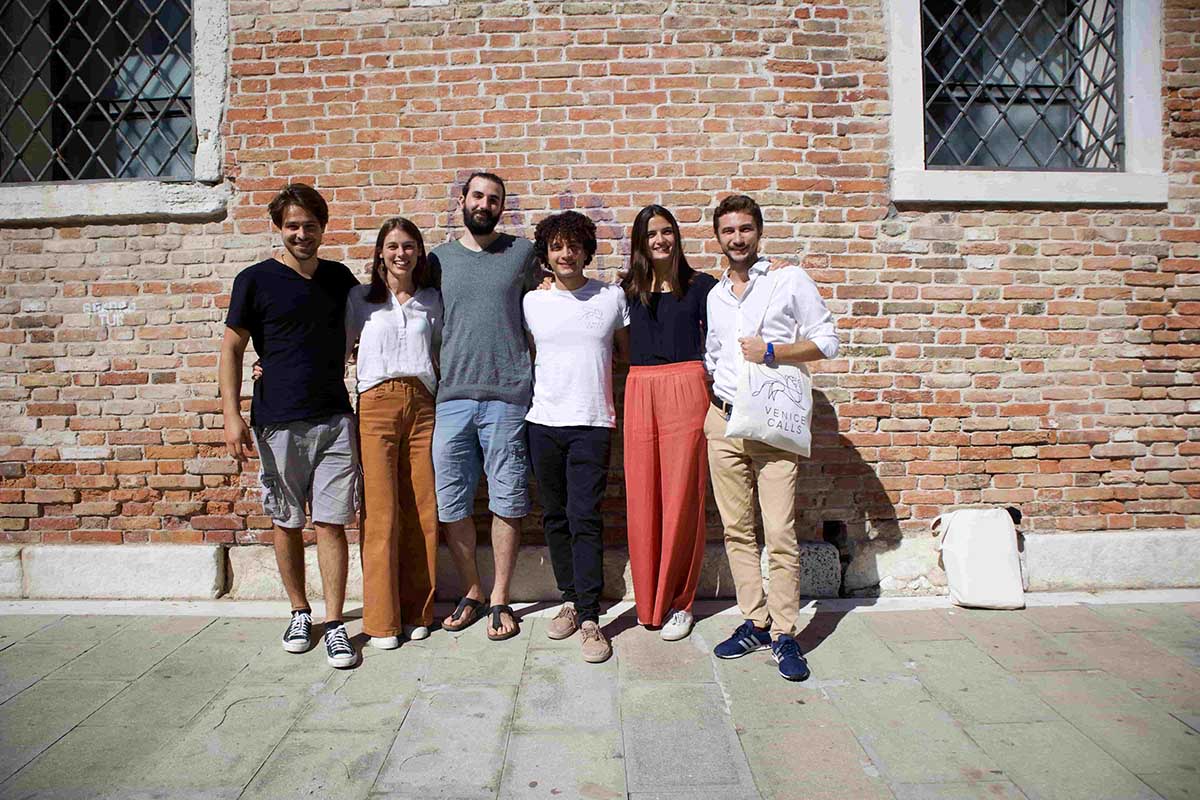
How are the plastic recycling machines you have purchased used? Is specific training required to use them?
E.S.: There are three pieces of machinery purchased:
- Shredder, which is used to shred plastic.
- Injection, which works with a pressure injection mechanism: plastic is partially melted and then inserted into molds to produce small objects. It is not a process that produces fumes, there is no risk of toxicity, just equip yourself with a minimum of personal protection, such as gloves and mask.
- Extrusion, with a similar process, makes it possible to produce larger objects, mainly bars (planks, table legs,…)
However, I would leave the floor to Carlo, our “recycled plastic craftsman,” who is very good at molding any kind of object with the molds obtained from our manufacturer.
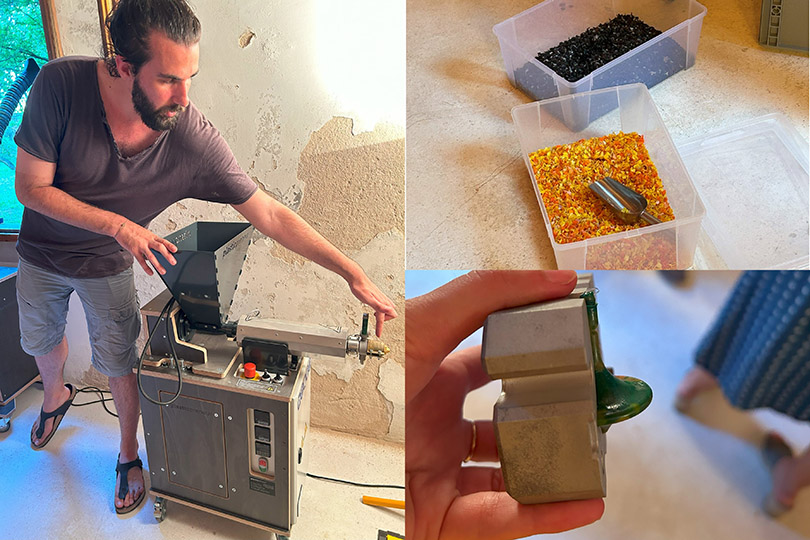
CARLO DURSO: Mainly the plastic we set out to recycle is HDPE, the material from which bottle caps are usually made, both for smoke and gas reasons. So we are sticking to an easy-to-process, high-quality plastic for the time being; but we also aim to broaden our outlook a bit as time goes on. To use the machines, you don’t need any special training, it only takes about twenty minutes to understand how they work, and then there is a lot of experimentation, especially now that we are trying to make slightly larger objects. There’s no manual that tells you how to make things: you have to try, fail, grind and retry. We started with a mold of a small spinning top, the product of a workshop. Now we have molds of a Frisbee and a seedling pot, which turned out to be more complex to make. For example, it proved necessary to use a furnace to heat the mold because the plastic was in danger of cooling before reaching the end of the mold. The final object then has the possibility of having four or five more lives.
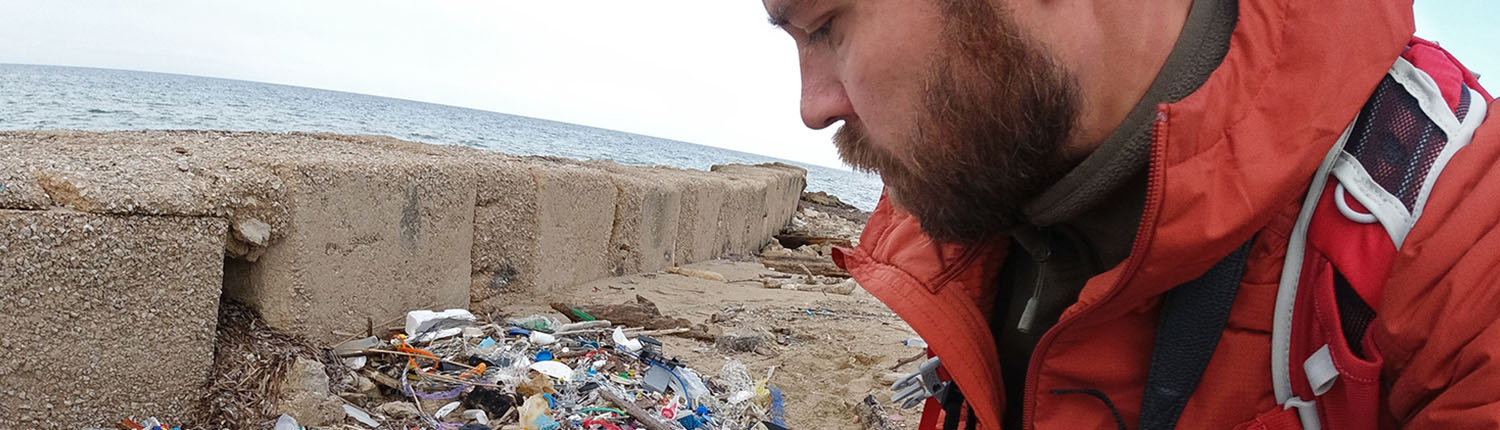
E.S.: That’s right, an important part is that there is no scrap from the process. We always have an eye on the sustainability of the process: they should not be disposable objects. They are still objects designed as play, or as decorative, but designed to be durable, not to be used for a few minutes and then thrown away. The goal is to prevent plastic from flowing back into the environment. In fact, most of the plastic production today is just disposable products, such as small bottles, snack packs, and bags, which are also most of the items they find on beaches or rocks in our clean ups.
C.D.: Yes, disposables are back in vogue after covid, certainly because of a greater focus on hygiene.
E.S.: There is a strong cultural change taking place today, but the dispersion of materials into the environment remains. We try to do our little bit to intervene. The Lab is closely linked to the clean up, not so much in the production flow, because after the clean up, thanks to our collaboration with Veritas [3] we return the waste to them for proper disposal. The logic we want to convey to the volunteer is that an object can be created from waste, which is given a particular value.
C.D.: Also, not all plastics can be recycled. If the bottle soaks in salt water too long, the structure is compromised: it is more fragile, it crumbles. This is also due to the hot/cold transition. The plastic is denatured, loses its properties, and cannot be readmitted into a recycling pathway.
So the plastic you recycle is always what you gather in your clean ups?
C.D.: Not only that. Once collected you do a sorting, what turns out to be unusable you use as a warning, during workshops, in which we show both the denatured plastic and a small window into what that object could have potentially become, if it had not been dispersed into the environment. Above all, our work is meant to be about creating a chain of awareness. Sometimes, however, plastic caps are brought to us by people who know the association, to support our workshop. In our small process, all our objects are molded to be able to have a long life cycle. The objects produced are not commercialized; the first one we made, the spinning top, was a gift for participants at the end of the workshop, as a memento of the activity.
E.S.: For waste management, we also did several consultations with experts and various recycling agencies in Italy. A small part of the collected plastic we use precisely for demonstration purposes, the majority we return to Veritas. We also work with caps brought in by our volunteers. The goal is to make people understand the product life cycle, what the different types of plastics are, where the problem originates and what the possible solutions may be Then this also leads to broader discourses related to microplastics, released from objects that remain for months, decades in water, and then also enter the food chain. A problem that is now becoming endemic in the Mediterranean.
How often do you do workshops? Who are they attended by? Are they open to everyone?
E.S.: Our workshops are free, we are currently in a planning phase for 2024. In 2023, the workshops were included in the project of the call with the municipality: in six months we did five, including one divided into two dates.
There are two ways of structuring the workshop.
The first is in collaboration with a partner, such as companies, associations, schools. Initially a planning work is done, an interested partner has to be found and a willing volunteer. Only certain people work touching the machines (like Carlo), we are all volunteers and we are students and workers, so it is necessary to frame our availability. The second is the “open lab“: the lab is open to the public, usually we also do a small event where we explain the activities of Venice Calls. In this way, people can come freely and if they wish then they can also sign up as volunteers. Last year we alternated between these two types of modes.
The activity can have different formats depending on whether the audience is more adult, or composed of teenagers, or children. For us, the relationship with schools is very important: students are the citizens of the future, the ones who can change the fate of the city. Last year we did a workshop with a French school and it was very interesting to see how the kids, fifth graders, were very participatory; they enjoyed the proposed activity and expressed their interest with many questions. We also did workshops involving university researchers: in that case we gave a more technical focus. It was nice to see how the same workshop can accommodate people from very different backgrounds, but they can understand the urgency of this issue.
C.D.: Yes, it is nice how this lab manages to excite both a high schooler and a technician.
How to be a part of Venice Calls? Do participants receive training, or are there any requirements?
C.D.: Ours is a proposal for everyone, of course it depends on what project you want to participate in and in what way. For example, to handle machinery, you have to know well what needs to be done, but it’s a bit of an exploration for us as well. We start from what was conceived as waste, so the raw material is zero cost. If even the spinning top gets twisted, it doesn’t matter: it’s an experiment. We usually try to pair a more experienced volunteer with a new one who needs to learn. We do a little training, based on the activity that is going to be done. We often work in groups, there is a lot of confrontation, and in my opinion you mature a lot by participating, both on the design side and the clean up side.
E.S.: You can also sign up for Venice Calls online, with a form on our website, where already while filling it out you can express your preferences in reference to the activities.
We have possibilities for collaboration that can change a lot, from clean ups to those who handle the lab machinery, for which a little more training is needed. Then there are those who deal with secretarial and treasury aspects.
Could you tell me more about clean ups?
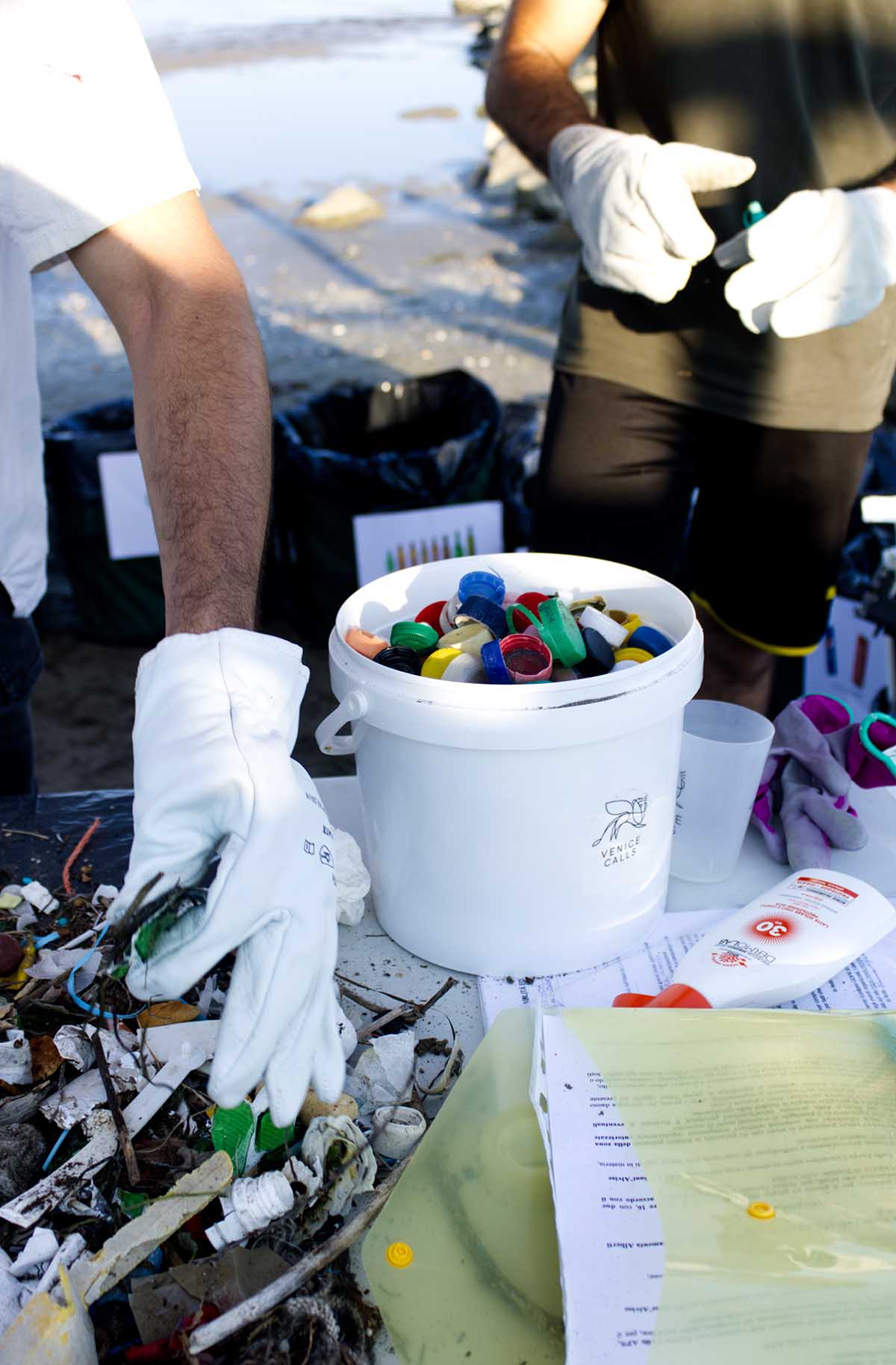
E.S.: We have a very defined methodology of waste collection, sorting and cataloging. There is the volunteer who simply goes and collects the waste and takes it to a collection center. They just bring gloves, we provide bags and tongs. Then there are the people who are in charge of sorting the waste into the various bins, to catalog what has been found. Some extra expertise is required for that.
C.D.: Let’s say there are two phases. The first one is the “little ant” who goes to collect the waste indiscriminately, and then the second one is at the collection center, where the waste is accumulated on a series of sheets. Other volunteers sort them into various bins for paper, plastic,…
E.S.: Other associations use different methods, in our experience this is very effective, because it allows us to collect as much as possible. It is a double activity, because when we all gather at the collection center we interact with all the other volunteers, so we also collect feedback, or even special reports.If anyone is interested in participating, you are invited to the next clean up, which will be held on Sunday, March 17, at Sant’Alvise and San Michele, in Venice, between 3 p.m. and 6 p.m.
Thank you for the invitation! A curiosity: do they always take place on land?
C.D.: We mainly intervene on land also because of a matter of inclusion: among all the volunteers, we would not have enough boats according to the number of people who come. Although it must be said that every boat ride with our president turns into a clean up! We pick up what we find in the canals, and we have noticed that on plastic collection days we occasionally see full bags floating around. Unfortunately with the water transport something gets dispersed.
E.S.: Yes, we also equip the volunteers with nets that were given to us by private donors and that allow them to collect suspended waste.
C.D.: More than by boat, we have used the boats to take volunteers to do clean ups in specific locations, in inaccessible, sometimes unmonitored areas, outside Veritas’ jurisdiction.
E.S.: A few years ago, for example, we came to the north of Burano, to one of those areas of the lagoon where litter unfortunately accumulates. Often these are also the richest areas from a natural point of view, unfortunately. So it is necessary to have volunteers who know the area well, know well how and where to intervene. Some international associations like Sea Shepherd have collaborated with us also for this reason: you act with people who know the territory and know how to act while preserving the ecosystem.
Where do you see yourselves in five years? If you were to list them, what are the quantitative and impactful results you would like to achieve?
C.D.: As far as the laboratory is concerned, I imagine it to be more expanded, with more machinery, with more capacity to do interesting things and at the same time more rooted in the territory. We would like to have more connections with universities and schools, collaborate with designers to concretize products for children to make in the lab, objects that can be charged with meaning and that can be used in the long term.
Six months after we started, we have already received several emails from different kinds of studios, for example 3D printing, design experts, we have also been contacted by an American artist who exhibited at the Biennale, so we have created this Venice/Detroit axis that we hope will continue.
Certainly the projects in these first six months were very much driven by the call, now we are in a phase of freedom, where we have to decide which are the priorities and what cut we want to give to the workshop.
From the point of view of Venice Calls, in the future I imagine that there is a network among the associations in Venice to respond to the problems of the area in the best possible way. This is a challenge that Venice Calls has set itself since its inception: to create social cohesion.
E.S.: I absolutely agree with Carlo. Five years from now, I see the Lab as a source of information and education, a meeting place where people in the field of sustainable design feel free to participate and find a place for experimentation. Also, I imagine we will continue to do waste collection, because of the serious problem of waste in the environment.
I would like Venice Calls to become more and more a network capable of connecting, optimizing and contingent. A place for social and cultural confrontation, where Venetians feel free to participate, meet, propose new ideas. The need comes from the fact that in Venice many places to meet have diminished, to make way for supermarkets or luxury hotels. Five years from now, I hope Venice Calls can help reverse that counter that there is in Rialto, where we young people are really the fundamental force to make that change. We need investment, we need policy, but we also need the citizens of Venice to perceive the city as a place of social and cultural expression.
Edoardo and Carlo wanted to share this last question with the other members of the association: the answer below expresses the vision of the Venice Calls of the future.
Venice Calls can become with the ‘commitment of its members the collector of third sector instances. A platform to get to know the active people for Venice. An association capable of aggregating the most proactive realities and able to carry out regenerative actions that can transform the perception of the city’s citizens. Alternatively, it will remain active to carry out educational projects for all those who wish to know a portion of the living city of Venice. Flag of resistance of a non-place.
[1] A one-day event promoting the environmental sustainability of Venice through three key concepts: Territory, Innovation and Community.
[2] A global event against climate change, with contributions from artists and professionals who want to protect the Venetian lagoon.
[3] Veritas spa is the company that manages Venice’s waste.

Literature graduated (UniMi), she is currently studying Environmental Humanities (UniVe). Hungry for stories, she loves writing about the environment and being provoked by people’s ideas. Determined and thorough, she likes to go beyond the apparent superficiality of facts. Her safe place is the library, but don’t be fooled: she is never punctual in returning books.
More articles