The push from the territory
One of the ways to reconcile such conflicting needs is to promote territorial initiatives. In fact, in this way it is possible both to raise awareness and involve the population through active participation and to achieve broader results through the deeper knowledge that citizens have of their own territory. No one knows and cares about the issues and characteristics of a place more than those who live there.

Amissi del Piovego, an environmental and cultural association based in Padua, was founded on this principle in 1980 following the observation of the devastating conditions of Padua’s canals. The main objective of the organization, headed by president Alessandro Campioni, is to safeguard and protect the inland waters first of Padua and then of the Veneto region, protecting them from pollution, 80% of which comes from the city itself. The association’s most original feature is that it integrates environmentalism (a fundamental connotation) with a broader vision of history and culture. The latter two elements are used as a filter to direct the association’s choices and projects.
Another quality of the association is its collaborative capacity: with regard to the care and cleaning of Padua’s canals, it has also acted as a social agent. In fact, Amissi del Piovego actively cooperates with the City of Padua and the University of Padua, which has introduced some new methods of intervention thanks to the research of the Department of Environmental Engineering. Moreover, the operational role is coordinated by a cooperative that educates and employs a selection of people with social fragility.
Water projects
One of the main projects is “Valorizziamo i canali cittadini” (= Let’s enhance the city canals), which consists of cleaning and collecting litter from both embankment and beehive areas, i.e. care in and out of the water. This operation is carried out manually: in fact, mechanical intervention destroys flora, encourages the emergence of weeds, and fragments plastic elements. Manual intervention, which takes place with the iconic “white gondolas”, allows the operation to be more carefully controlled and samples to be extracted, which will later be analyzed in the University’s laboratories.
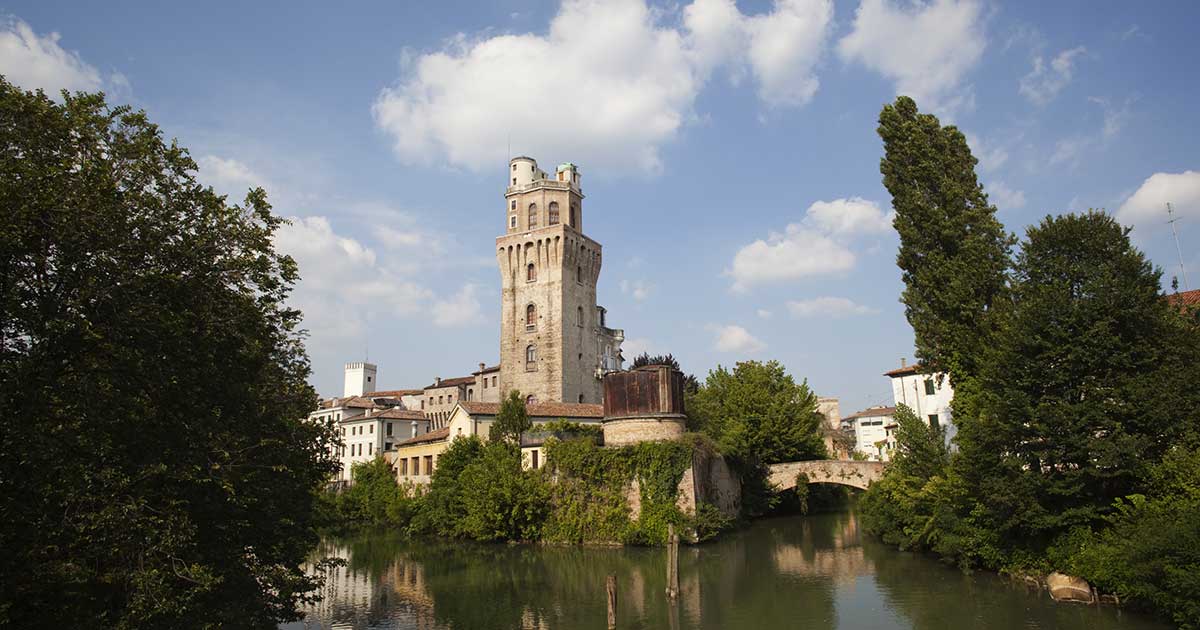
“Parco delle mura e delle acque” (= Wall and water park), on the other hand, is a project that aims to form a large urban park within the city. The extension of the walls of Padua, second in Italy only to those of Turin, is at the center of the association’s enhancement work, which aims to revitalize the unicum composed of the walls and its waters through the restoration of fifteen “stations” positioned in specific locations and a complete renovation of river structures and the green plan.
Another major intervention promoted by the association is the reopening of the old canals (for example that of San Massimo, which flows under the area of the old hospital). Although the common mindset leads to consider the presence of uncovered water as synonymous with unhealthiness, it is exactly the opposite. In fact, beyond the landscape benefit and the increase in green areas within the urban fabric, the utility is above all environmental: the thermal capacity of the water allows for the mitigation of temperatures in cemented areas.
In addition to the projects illustrated, the initiatives, as already mentioned, are also historical and cultural in nature. For example, great attention is given to the history of the canals and the wall-water complex, cultural tours of the water spaces are offered (for instance, during the “Gothic Padua” event), and traditional Venetian rowing is promoted.
Amissi del Piovego thus lends itself as the best example to show how precisely the citizens, supported by a collaborative network, can be the first promoters of greater care for their territory. In Padua, the activities promoted are certainly environmental, but they also generate knowledge, critical spirit in the community and new jobs for the most fragile social groups, thus creating the conditions for the reconciliation of innovation, social growth and environmental foresight.

PhD student in Philosophy (Unipd), she deals with Art and Artificial Intelligence. Interested in the relationship between Nature and Culture, she is the editor of Atmosphera Lab.
More articles