Coca-Cola and water consumption
Candler’s advertising campaign was a real success that led Coca-Cola to expand beyond national borders. From this expansion of the brand came a series of corporate policies of dubious ethicality. In fact, one of the secrets of its success was keeping production costs low by drawing water from local sources, yet causing environmental problems of no small magnitude.
Since the drink mostly consists of water, the entire production requires large quantities of it. In this way, Coca-Cola turns out to be not only a carbonated soft drink company, but in effect also a distributor of substantial water resources. Therefore, the continuous drainage of local water supplies has an increasing substantial impact on the environment and local farmers.
According to a third-party assessment, in 2010, to produce even one half-liter bottle, the company used 150 to 300 litres of water. Of the water used, 99.8 percent was used to prepare ingredients such as cane sugar, a food that requires a huge amount of water for its production.
Water consumption is also particularly significant in the bottling process. In fact, in 2004, Coca-Cola had to shut down a bottling plant in Kerala, India, because it was sucking up too much groundwater. Following this event, similar incidents have occurred elsewhere. For example, in 2014 Indian farmers in Varanasi protested against a Coca-Cola plant because of excessive consumption of local water resources diverted from their agricultural activities. These protests led to the permanent closure of the plant.

Solutions to the problem: are they really effective?
In 2018, in the face of this reputation, Coca-Cola announced that it was changing course, saying it intended to reintegrate 100% of the water used to create its beverages back into local water systems. But according to an investigative report published by The Verge, this would be pure greenwashing since, despite the premise, Coca-Cola is still proceeding with a business-as-usual strategy.
Moreover, in certain situations, the sustainability projects promoted by Coca-Cola have made things worse than they were at the beginning. For example, the digging of irrigation canals funded in Mexican National Parks in order to improve growing conditions for some tree species has done more harm than good.
The Mexican government’s forestry commission, endorsed by sound scientific studies, has pointed out that this practice has not actually improved conditions for vegetative growth, on the contrary increasing soil erosion and forest degradation.
Problems with packaging: the high consumption of plastic
In addition to the indiscriminate use of water, another problem caused by Coca-Cola is the intensive use of plastic for bottling. Every day this company sells about 1.9 billion drinks and almost all of them are bottled in plastic. Despite the statement by Enrico De Giuli, Country Operational Sustainability manager of Coca-Cola HBC Italy, that the company’s products are recyclable, some concerns have been raised over time.
In fact, if in the 1950s Coca-Cola bottles were packaged in glass and had a void deposit to the value of 40 cents so that the packaging could be reobtained and reused, with the entry of disposable plastic Coca-Cola drastically changed its bottling packaging in order to reduce production costs.
Recently, the Atlanta-based company admitted to be producing more than 3 million tons of plastic each year, the equivalent of 200,000 plastic bottles every minute. Although Coca-Cola bottles are made of PET plastic, HDPE caps and PVC labels – all easily recyclable materials – most are not actually recycled. Here, however, it is necessary to point out that this does not directly result from internal company policies, but rather occurs because of unethical behaviour by individual consumers. Therefore, it could be hypothesised that one of the determinants of a brand’s level of sustainability is definitely the attitude of its customers toward the environment.
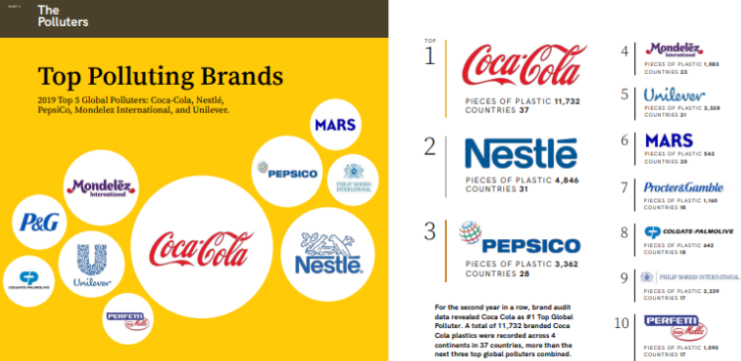
To underscore this collective image, an audit estimated that in 2018 and 2019 Coca-Cola was found to be the brand with the most waste in the ocean, followed by Nestlé and Pepsi. In essence, since the 1970s, with the adoption of plastic packaging, Coca-Cola has increased its impact on the environment, local communities, and in the oceans.
To remedy these problems, Coca-Cola has launched a series of campaigns to combat waste pollution, such as “A World Without Waste?” in 2020, based on the idea of making the life cycle of Coca-Cola packaging more circular and sustainable, hoping-among other goals-that for every bottle purchased, every consumer will reuse or recycle another one.
However, while these kinds of initiatives may seem like steps toward greater awareness of one’s impact on the environment, they also risk becoming mere attempts to impute one’s faults to someone else, only emphasising how it is individual citizens who are the polluters, for example, by not sorting their waste.
Future Visions
These are just some of the problems Coca-Cola has had over the years regarding its approach to sustainability. Despite the campaigns launched with the aim of raising awareness among their buyers and their strategies to reduce their environmental impact, they have not always been successful.
It would therefore be worthwhile to think about substantial changes in company policies, so that there can be real breakthroughs and a more sustainable production model is implemented within this soft drinks market giant.

Graduated in Environmental Humanities from Ca’ Foscari University in Venice. He is passionate about sustainability, food, geography and animal studies, mainly in relation to contemporary issues. He found Atmosphera Lab a perfect place to express himself.
More articles