Fonte foto: Autostrade per l’Italia
The KEHV project in practice
To fully understand this project and its environmental implications, it is first necessary to analyse its structural components.
The ultimate goal is to recover the otherwise dissipated kinetic energy of vehicles at the exact moment they decelerate in order to convert it into electrical energy.

Image source: Autostrade per l’Italia
The KEHV takes the form of a “carpet” flush with asphalt measuring approximately 3×3.5 metres, better known as the Lybra plant (technology developed by startup 20energy Srl and used by Movyon). When a vehicle passes over it, it experiences increased rolling friction on its wheels, absorbing kinetic energy. This activates a patented generator that can convert the absorbed energy into electricity, which is eventually stabilised and sent to a standard photovoltaic inverter for self-consumption.
The latter can thus be used in a variety of contexts and numerous applications, including lighting stretches of road, powering charging stations and toll booths on highways. According to estimates proposed by the company Lybra, the passage of 150 cars on a single carpet is enough for an amount of electricity equal to 1 kWh to be produced. Although this may seem like an insignificant contribution, when larger numbers are considered the figures begin to become attractive: with the transit of 7,500 vehicles it will be possible to recharge an electric vehicle with a 50 kWh battery for free.
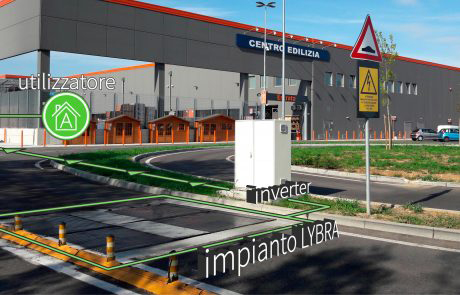
Image source: La Gazzetta dello Sport
Advantages and disadvantages for the environment and humans
How does this translate in terms of environmental protection? According to forecasts by ASPI (Autostrade per l’Italia S.p.A.) in the Arno East area alone, which has an influx of about 9,000 vehicles per day, using such technology instead of fossil sources would save 11 tons of CO2, (the equivalent of 30 MWh).
Wanting to transpose the discussion to particularly busy cities and therefore suitable for embracing such a solution, the results would be even more satisfying: South Milan and North Milan alone see the passage of about 71,000 vehicles per day (broken down into 63,000 light and 8,000 heavy), or 400MWh in a year. Energy that could be used to recharge electric cars with 50 kWh batteries, thus saving our ecosystem 70 tons of CO2 per year (considering that in our country the conversion factor is 0.58 tons of CO2 emitted for every MWh produced).
This argument can therefore be repeated in all those junctions that are very crowded, avoiding the production of energy from fossil fuels and allowing a much more effective storage of it than other solutions already present, especially in terms of predictability: if the traffic is estimable and therefore can ensure an almost constant income of energy, the same cannot be said of the energy obtained from photovoltaic systems, which are susceptible to weather variations.
Among other advantages, it is necessary to emphasize the discretion with which the systems developed by Lybra interface with the existing landscape: in fact, roads are not eroded or dismantled but substantially upgraded, without major long-term interventions.
The only noteworthy disadvantage: it is clear that this technology cannot be exploited in road sections with little traffic but only in areas with certain prerequisites in terms of viability and usability.
The application success of the KEHV project
Analysing the first results of the KEHV project, the latter proved to be effective at its first installation and therefore promising from an environmental point of view in view of future applications in further highway sections (in fact, it proved to be an excellent addition to the already existing photovoltaic system).
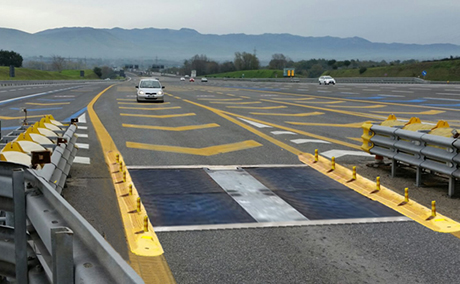
Image source: 20energy.it
It is also important to note that it joins the Mercury Smart Sustainable Mobility program, a plan once again implemented by the Autostrade per l’Italia Group with the intention of creating a single large unified system of infrastructure designed for the decarbonization of transport services: structured in 5 clusters, its usefulness affects not only the environment but also the entire community by bringing improvements that involve both urban mobility (through the conception of smart cities) and highway mobility. In fact, in addition to the KEHV project, the C-ITS project is also taking shape, which is a set of information that is sent to the driver in order to avert accidents and reduce traffic congestion.

Graduated in Journalism, Editorial Culture and Multimedia Communication from the University of Parma, she loves interfacing with new realities. An aspiring traveller, she has a keen eye for ecology and human rights. In Atmosphera Lab she has found a valuable ally to communicate what is closest to her heart.
More articles