The structure of Agenda 2030 consists of a list of seventeen Sustainable Development Goals (SDGs) each consisting of multiple points, for a total of 169 targets. The seventeen goals are heterogeneous but intimately connected: they range from combating poverty and gender inequality to safeguarding fish and terrestrial biodiversity, from emphasizing responsible management of consumption and production processes to promoting peace and social justice. The goals and their targets have been developed through the definition of indicators by the UN Statistical Commission, which is engaged in coordinating work that can establish international standards, methods and guidelines.
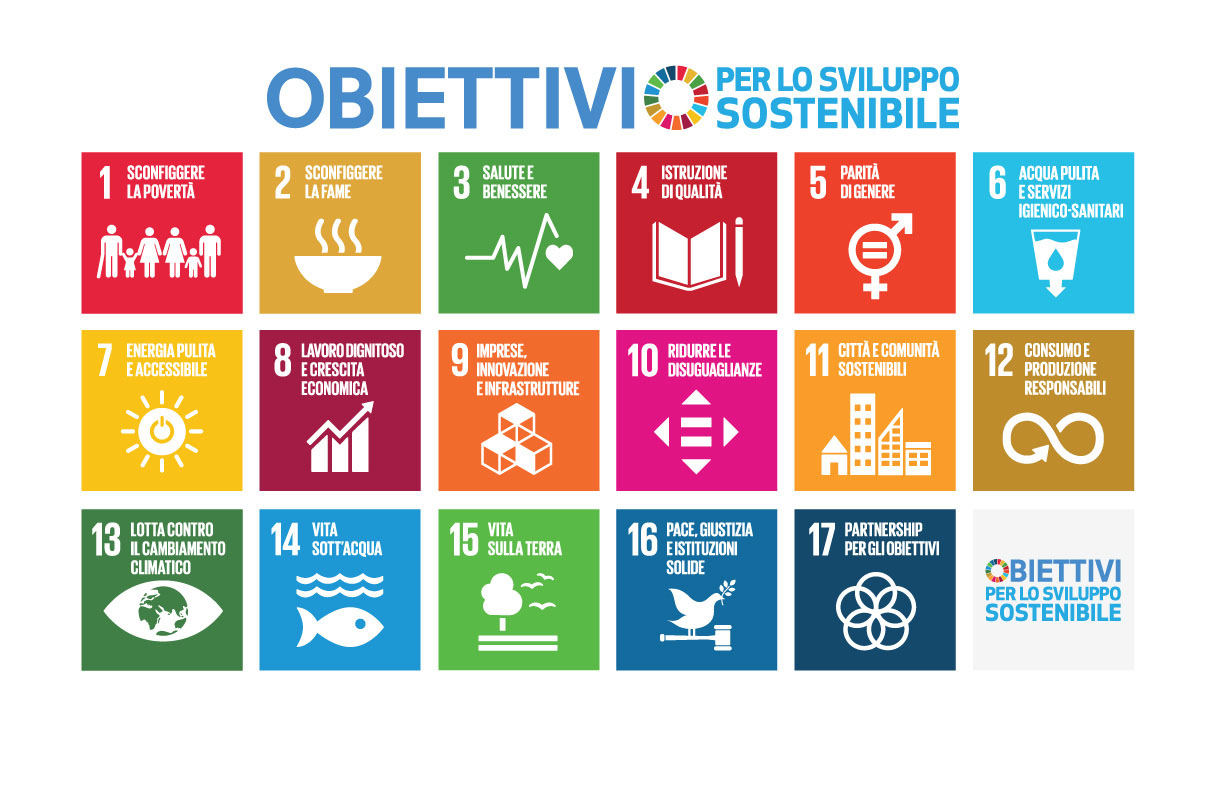
Image Credits: UN, UN Regional Information Center
Which sustainability?
The issues addressed by the 2030 Agenda are very diverse: only some of them primarily concern environmental defense and combating climate change. It is interesting to note this aspect, where usually the environment is considered to be the area implicitly called into question by any discourse that uses the word “sustainability”. Instead, one must emphasize the great breadth of this notion.
First, the complexity that this paper attributes to the concept of sustainability justifies its consideration in conjunction with the Pasolinian notion of progress, because of the forward-looking and forward-looking component it implies. In fact, “sustainable development” indicates development that takes place in the present but without compromising future well-being. Far from being promoted to the detriment of what comes next, sustainable development implements innovative strategies aimed at bringing about long-term improvements in a considerable range of areas. As Enrico Giovannini, an economist among the founders of the Italian Alliance for Sustainable Development (ASVIS), has pointed out, this does not proceed by improving what has been done in the past, but by radically changing the paradigm of action.
What has been pointed out leads us to a second consideration: the fight against climate change itself cannot proceed unrelated to issues of another kind, and of a more strictly social, political, and economic nature. On the contrary, only by seeing environmental protection as a momentum of a broader design will it be possible to address this issue in all its complexity: taking into account not only the network that embraces human and nature together, but also the complex system in which different interests and needs are intertwined, in which the environmental issue itself is placed. According to Giovannini, deeming sustainability to be an issue exclusively concerning environmental defense is indeed a “very serious conceptual error, with dramatic consequences on economic and social policies conducted throughout the world” [7].
A special case: sustainability and librarianship
We now come to the particular perspective whose profile we intended to draw in light of the seventeen Sustainable Development Goals. The reference to libraries is not accidental: on the contrary, in the public library as a cultural institution, characteristics are intertwined that allow us to gain a privileged perspective for a discourse on Agenda 2030. Indeed, libraries are common and widespread institutions: although poorly attended – according to ISTAT in 2022 only 10 percent of the Italian population attended public libraries – they are democratic, easily accessible, free institutions. Therefore, they can become a garrison for designing an everyday life in accordance with the agenda of Agenda 2030.
It is true that, except for the goal related to Quality Education, none of the seventeen SDGs explicitly refers to the cultural and educational dimension, let alone libraries. However, the same broad meaning of the concept of sustainability set out here should lead us to grasp how this element, neither negligible nor incidental to our life and its well-being, is in truth implicated in all the points touched upon by the 2030 Agenda.
Indeed, the role of cultural goods in general and libraries in particular represents a privileged vantage point for understanding the notion of sustainable development, as well as a tool for acting consistently with it [8]. See, for example, the monitoring of the measures or rather the experiences promoted by libraries to achieve the seventeen goals of the 2030 Agenda – recorded through a qualitative and narrative approach, based on a true storytelling practice – and subsequently collected in the Library Map of the World, produced by the International Federation of Library Associations and Institutions (IFLA). On the other hand, numerous studies produced by contemporary librarianship underscore not only the extent of the role of libraries for the SDGs, but also how Agenda 2030 can provide a perspective angle through which to rethink the identity of libraries and their social value [9].
For a theory of sustainability that is a practice of planning
A clarification is necessary as we come to the end of the path we have taken. In the face of the urgency to which the real calls us, with the wars currently underway but also asking us to take a stand with respect to more circumscribed debates, questioning the meaning of a word may appear to be a waste of time. Attempting to explicate the richness of the concept of sustainability, showing how the crasis that divides development and progress is resolved in it, may seem idle. In truth, precisely because theory and praxis claim their intimate connection, even such a discourse leads us toward the need to design the present and the future.
Of course, the problems we face today are no longer, or at least are not only, those dealt with by the social criticism of the 1970s. In the face of the maze of issues in which our contemporaneity reverberates, it is possible to find in the notion of sustainability a north star that allows us to orient ourselves in the “even daily and physical life” evoked by Pasolini’s pages. It is up to the concept of sustainability and the role currently given to it, enshrined in Agenda 2030, to offer the extremes for a meditation and, above all, a practice that distances itself from the risks and limits of development without progress. Indeed, this would only be development without planning therefore, we would say, without future.
[1] P.P. Pasolini, Sviluppo e progresso, in Id., Scritti corsari, Milano, Garzanti, 1975, pp. 219-223, here p. 219.
[2] Ivi, p. 220.
[3] H. Daly, Beyond Growth. The Economics of Sustainable Development, 1996; tr. it. Oltre la crescita. L’economia dello sviluppo sostenibile, Torino, Einaudi, 2001.
[4] United Nations, The Sustainable Development Goals Report 2023: Special Edition, 2023: https://unstats.un.org/sdgs/report/2023/.
[5] C. Faggiolani, Introduzione: uno sguardo nuovo sulle biblioteche, in Le biblioteche nel sistema del benessere, curated by C. Faggiolani, Milano, Editrice Bibliografica, 2022, pp. 11-26.
[6] United Nations, Resolution adopted by the General Assembly on 6 July 2017. Work of the Statistical Commission pertaining to the 2030 Agenda for Sustainable Development, 2017: https://digitallibrary.un.org/record/1291226.
[7] E. Giovannini, L’utopia sostenibile, Bari – Roma, Laterza, 2018.
[8] G. Di Domenico (curated by), Il paradigma della biblioteca sostenibile, Milano, LediPublishing, 2021.
[9] C. Faggiolani, Misurare, valutare, raccontare le biblioteche italiane oggi, guardando ai 17 obiettivi di sviluppo sostenibile (SDGs), «Biblioteche oggi», vol 5, 2019, n. 1, pp. 68-80.

Graduate in Philosophy from the University of Padua, she is currently a student in Philosophical Sciences at the same University. She approached Atmosphera Lab with the intention of combining, in a rigorous form, expressive practice and research on such an important topic as environmental issues.
More articles