The start-up Human Maple has tried to respond to the challenge of cigarette dispersal in the environment through an innovative approach that relies on gamification.
The ashtrays-survey: better sea or mountain?
Human Maple is a CleanTech company in Castelfranco Emilia, in the province of Modena, named after the curly maple tree, because it is the tree that collects the most CO2. The basic idea, Alì Benkouhail, the company’s CEO and co-founder, explains to me, is to turn people into human maples, who help restore the environment just like they were trees.
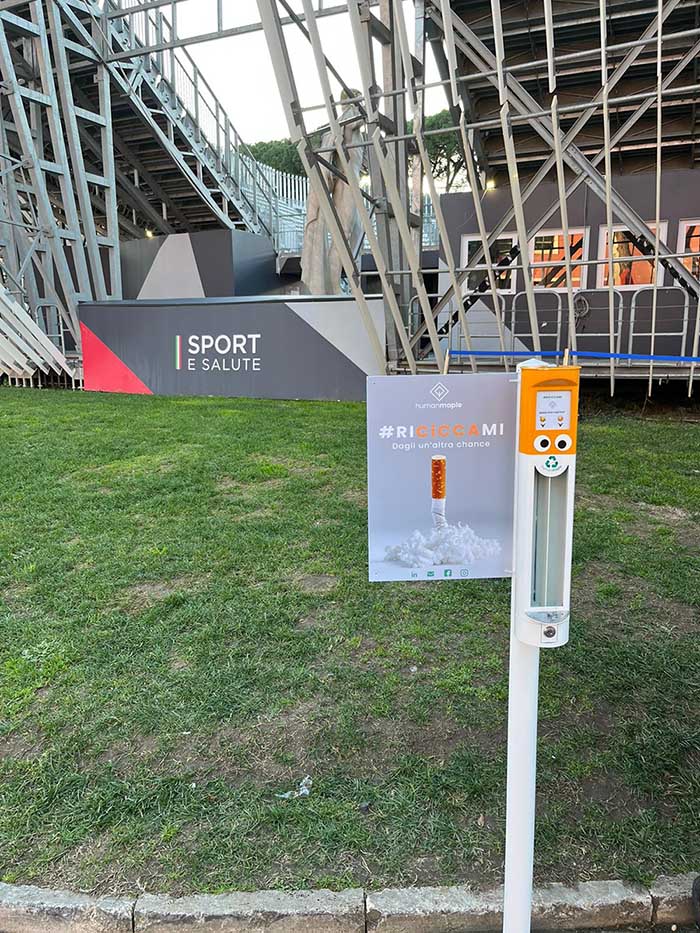
“We want to combat so-called littering, which is the scattering of cigarette residues. One of the ways we have come up with, which has actually already been validated in Northern Europe, such as in the UK and Germany, is the use of survey-ashtrays. Our ashtrays are easily recognizable: they are shaped like a cigarette and have two eyes that correspond to two entrances equipped with a clear glass. The glass shows the cigarette filling more on one side or the other. At the top is a question: for example, better tortellini or lasagna? Christiano Ronaldo or Messi? Mountain or sea?” explains Benkouhail to me.
Indeed, they work on gamification, that is, the use of elements borrowed from games in nongame contexts, such as precisely in the act of choosing where to throw one’s cigarette. “Unfortunately, ⅔ of smokers throw their cigarette on the ground. With the ashtray-vote, the smoker is asked to insert it into one of the two eyes, and in this way the collection is incentivized. If I have to vote, my cigarette acquires value, so instead of throwing it on the ground, I put it there.” adds the CEO.
Maple ashtrays are distributed throughout the Italian peninsula. The question on the ashtray is agreed with the customer, so it varies depending on the location: “For example, we installed an ashtray in Piazza Verdi, Bologna, and there it says, Virtus or fortitudo? Let’s say that depending on the target audience the question changes. In Apulia we put: ‘Primitivo or Malvasia?'”
From residue to jacket: Human Maple’s other goals
Human Maple also designed the #Riciccami (from: “recycle me” and “cigarette”) campaign, which works on Goals 11 (Sustainable Cities and Communities) and 12 (Responsible Consumption and Production) of the 2030 Agenda. The project aims to properly dispose of cigarettes and turn them into a recyclable material that is later used by third-party companies in the fashion industry.
Benkouhail explains how the storage process works, “First the cigarettes have to be dried, then they go through a machine that removes the ash and tobacco. This is followed by a shredding stage, at the end of which a ball of cotton and paperboard comes out, with some aluminium pieces, which are then separated with a roller using magnetic electrodes. Finally there is a machine that separates the paper, which becomes a waste, from the cellulose acetate, which is set aside and washed in tanks with organic solvent. After three washes, there is a drying phase. Once dried, the acetate has become a ball of cotton that has strong heat-insulating properties, so it can be used in the field of padding to make jackets, pillows, key chains, and plushies.”
Also included in the #Riciccami project is a part of environmental education, which can target businesses, or schools and summer centres. “Working with children is very rewarding. We teach them how the waste cycle works through interactive games. For example, children have to guess where you throw items, and the team that does the best recycling wins.”
What if everyone stopped smoking? The CEO of Human Maple replies, “Well, we would rejoice, because we are against smoking! In fact, we are already going in that direction: there are some states, such as New Zealand, where cigarette smoking is banned for those born after 2008. It should be mentioned that smoking of e-cigarette filters is not banned. Between now and 2050, it seems that the goal is to turn combustion cigarettes into electronic cigarettes. For our business this is not a problem, because we can recycle those as well. Clearly, if one day everyone stopped smoking, we would be happy, and as a company we are already investing in other recycling projects.”
On the cigarette front, so many divisions are still ongoing due to cultural differences (and mistrusts). Regarding the cigarette ban law mentioned by Benkouhail, which was proposed by Jacinda Arden’s former government and passed in 2022, it must be said that already in November 2023 the new centre-right government backtracked, removing the ban. The question arises: will our grandchildren still smoke cigarettes?

Literature graduated (UniMi), she is currently studying Environmental Humanities (UniVe). Hungry for stories, she loves writing about the environment and being provoked by people’s ideas. Determined and thorough, she likes to go beyond the apparent superficiality of facts. Her safe place is the library, but don’t be fooled: she is never punctual in returning books.
More articles