«There is greater biodiversity — that is to say, a larger number and greater diversity of fish, coral, and mollusks — on these reefs than anywhere on earth. A single football field-sized patch of Misool’s reefs has nearly five times the number of coral species as the entire Caribbean Sea.»
Dr. Mark Erdmann, marine biologist, coral reef ecologist.
Misool – Raja Ampat Archipelago
The one of Misool is a fascinating demonstration that it is possible to deviate from the ordinary trend for the rest of the world, promoting the development of biodiversity. Misool is one of the largest islands (Pulau) in the Raja Ampat archipelago, West Papua province, Indonesia. Within its perimeter, an internationally recognized species conservation and protection area has been designated since 1982. Misool, a site already characterised by its strong biodiversity and hotspot of specific richness, has undergone a radical conversion: from a shark-hunting camp it has become an eco-resort (or conservation centre), which promises to bring tourism closer to species conservation and the preservation of pristine spaces.
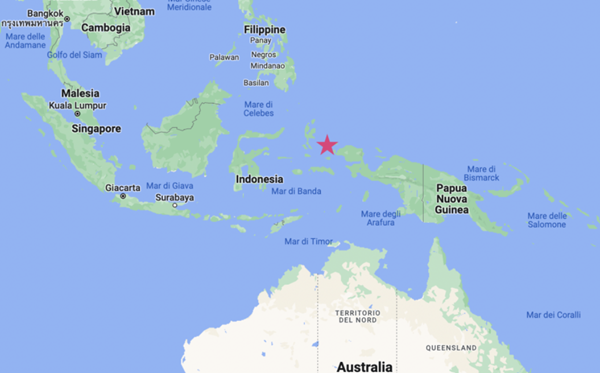
Geolocation of Misool
The Raja Ampat archipelago is home to a total of about 50,000 inhabitants, and it is essential that human activity, mainly traditional fishing, be kept at low incidence and interference so that this habitat is preserved and encouraged to greater diversification.
To date, compared to the period of intensive shark hunting, it appears that the number of sharks has increased twenty-five times and the number of fish tripled. This is why Misool, and the Raja Ampat archipelago, are cited as the most pristine of environments and having the highest marine biodiversity.
The data collected suggest that there are more than 600 species of hard corals, corresponding to about 75% of the globally known species, more than 1,700 species of reef fish found in the waters of the archipelago joined by rarities such as carpet sharks, which live on the seafloor, and other threatened and endangered mammals: orcas, dolphins, whales, and dugongs, the latter being at the forefront of Abu Dhabi’s territorial revaluation as well.
Restore, renew, renaturalise
In the fight against the disappearance of biodiversity, there are several virtuous examples, including those in Misool, where habitat conservation wins due to the reduced influence of human activities in the area.
Another case in point is Atacama, one of the driest deserts on earth where it has not rained for about 400 years, located between Peru, Chile and Argentina. Until the 1960s, despite the substantial absence of life, it saw colonies of millions of cormorants and other birds lodge on its shores because of the large presence of fish in the sea. However, intensive fishing drastically reduced the amount of fish relied on by the birds residing there during breeding and nesting. It was thanks to the introduction of policies to dampen intensive fishing that the area has been able to gradually return to host the birds that during the past fifty years abandoned this nesting site due to lack of livelihood.

Atacama Desert, Chile
Copyright: The Guardian
In reference to the abundance of biodiversity and the rate of species extinction, our present has been called a period of mass extinction, the sixth to be exact.
Where for some it is still a scepticism, for others it is the reality into which we have perilously wandered, as reporter and writer Elizabeth Kolbert reminds us in her book of the same name, The Sixth Extinction. Kolbert traces the major events of the past 500 million years dwelling on the natural reasons that triggered the other large-scale extinctions (at least five). In some cases it was prolonged drought, in others abnormal rising temperatures, the most famous being an asteroid impact. This latest mass extinction, despite the naturalness of the phenomenon, can be traced to a single driver: humans. Pollution, land shrinkage and climate change have drastically impacted the natural construction of a biodiverse ecological structure. A research published in Biological Reviews highlighted the numbers: 7% to 13% of known species may have disappeared since 1500. It chimes in with the latest Ipbes report (2019), warning that about one million species are at risk of extinction.
Humans are the only species capable of manipulating the biosphere on a large scale, producing enrichment and disappearance, prosperity and extinction of Earth’s diversity. The results produced by these activities are tangible, often disturbing, sometimes virtuous. Just as in the case of Misool, which teaches that trend reversal is possible.

Graduated in Environmental Sciences and student of Environmental Humanities at Ca’ Foscari. Passionate about the environment, innovation and communication.
More articles