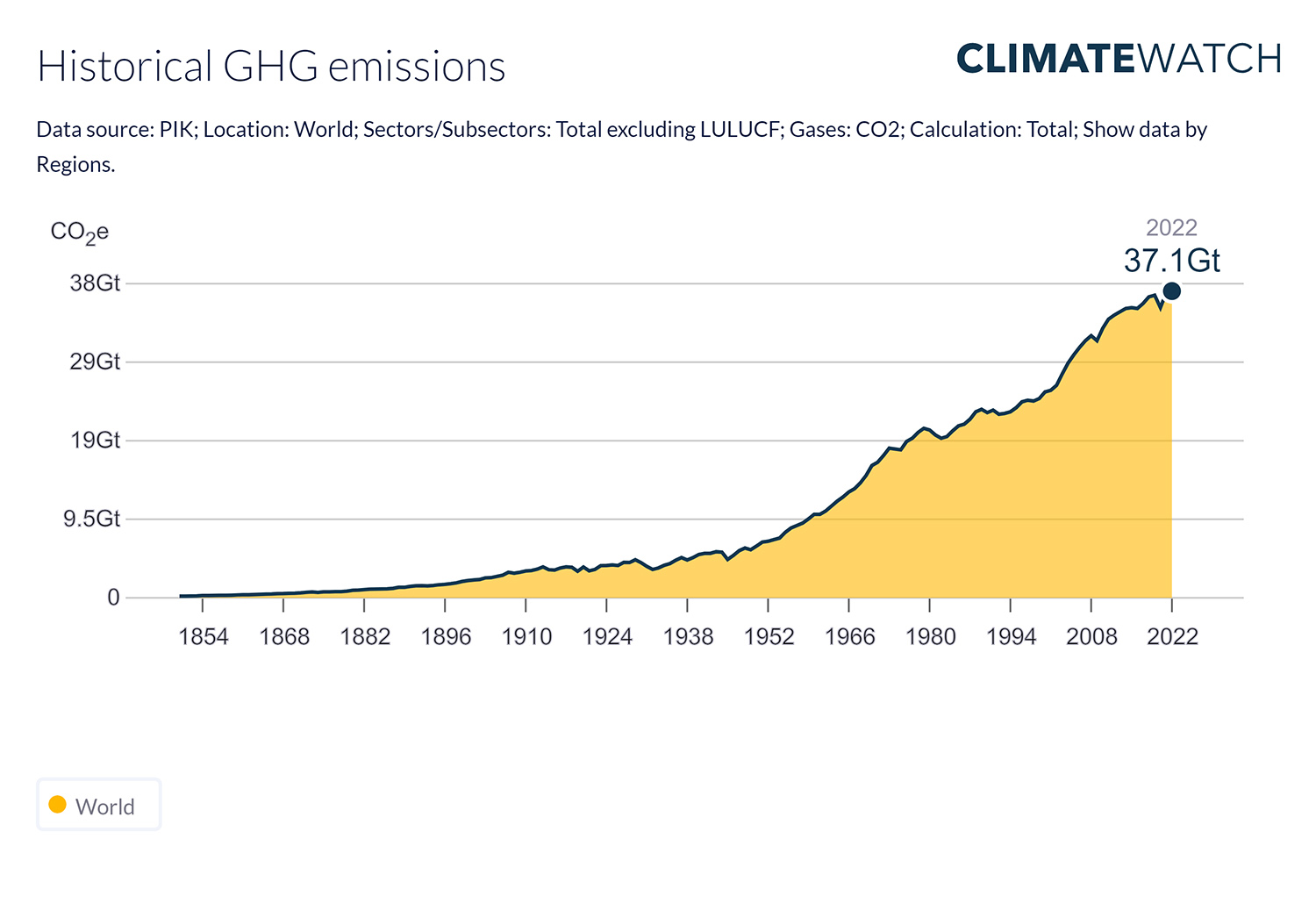
Figure 1: Historical greenhouse gas emissions expressed in CO2 equivalents (CO2e) from 1850 to the present. Source: ClimateWatch.
The Convention set the limit for the concentration of CO2 in the atmosphere at 450 parts per million (ppm), above which there would be ‘dangerous effects’ for humans. Last August, at the Mauna Loa Observatory in Hawaii, where the atmospheric CO2 concentration has been measured since 1957, 422.99 ppm was already recorded. After 1992, other international climate cooperation initiatives followed: the Kyoto Protocol in 1997, the Copenhagen Summit in 2009, and finally the Paris Agreement in 2015. In the latter, the two principles of conduct of nations around the world are codified: limiting the temperature increase to 1.5°C above pre-industrial levels and requiring the contribution of each country to achieve the common goals. However, the signing of these commitments and their actual achievement are explicitly voluntary, and although all the nations of the world participated in Paris, the fate of the treaty remains uncertain and unlikely.
Why after more than 30 years of negotiations is there still no solution? Why are climate treaties increasing but CO2 not decreasing? The climate crisis is not an insurmountable scientific problem; instead, the basis of this international crisis is economic and political. The issue of climate change belongs to a particular type of mathematical problem studied by game theory known as the prisoner’s dilemma. A game is defined as a certain type of strategic interaction between two or more participants, i.e., relationships in which each party knows that the benefits he or she will gain-from the interaction-depend on the actions of all. The strategic interaction for cutting CO2 – how governments around the world cooperate to mitigate their emissions – is described by game theory as an interaction between two or more parties in which the benefits from the dominant strategy – that is, the action that guarantees one player the greatest benefits regardless of what his or her opponents will do – are lower for each player – and thus lower overall – than if the players chose a different strategy. In other words, in the prisoner’s dilemma, the choice that guarantees the highest profit is not the best choice from the perspective of prolonged interactions with other players over time. The determining factor in this strategic interaction is that the decision of the other party remains unknown but is relevant to the final outcome of both players.
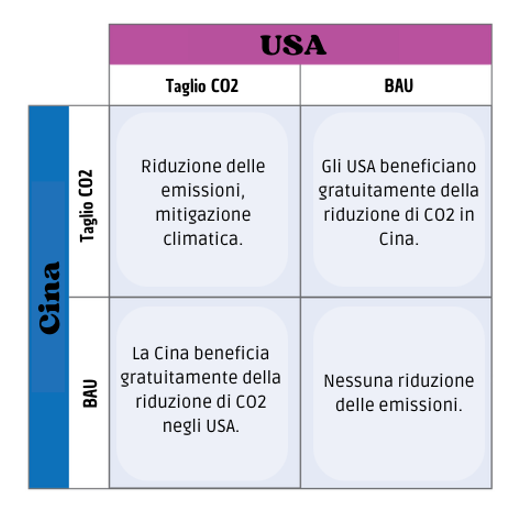
Figure 2: The Prisoner’s Dilemma of Climate Change Policy between China and the United States. Elaborated by Atmospheralab.
Do you cut or do I cut?
Let us understand where the dilemma lies with an example. There are two players – China and the US – each with two possible strategies: cut emissions or do nothing, a strategy known as BAU – business as usual.
The image shows the possible results of the interaction. The dilemma is obvious: no matter the opponent’s strategy, for each player the choice that generates the most profit is to do nothing – BAU.
Remember that the players do not know the strategy adopted by the opponent. So, if the US thinks that China will mitigate emissions, their dominant strategy will be BAU, because China’s CO2 cut will benefit everyone – including the US, which can take advantage of China’s climate mitigation efforts for free (in economic jargon this is called a free ride). Conversely, if the White House believes Beijing will do nothing, it will be forced to do the same so as not to give China a free ride. In this case, the US will have a smaller balance than in the first case, but greater than it would have achieved by cutting its own emissions. On the other hand, China will make these same considerations and come to the same conclusion. The unfortunate endgame results in a strategic balance unfavourable to both nations (BAU-BAU), although the decision of each is the best response to the opponent’s strategy.
It is clear that in our simplified example we do not consider various aspects relevant to cooperation between the two players. We could introduce new rules of the game: reciprocity, altruism and aversion to inequities. Moved by a feeling of reciprocity, the U.S. would not hesitate to cut its emissions if it felt that China would do the same. Moreover, both players could internalize the costs of their actions inflicted on their opponent with the introduction of the inequity aversion criterion: if the U.S. continues to exploit fossil fuels for its own national growth by imposing a social and economic cost on China – deteriorating quality of life and infrastructure costs, the White House could compensate for its actions through climate mitigation or adaptation projects – energetic efficiency, reducing emissions from industrial processes, improving agricultural land and forest management, developing renewable energy, protecting critical ecosystems, reducing ozone-depleting substances or sinking algae for C02 storage. Finally, both nations could reach a new – yet another – climate agreement. The apparent simplicity of the causes of the climate crisis contrasts with the difficulties in finding a solution to it. The real world is in fact much more complex, there is not just one pair of players, but hundreds; moreover, climate issues are linked to historical, geopolitical and ethical issues among the different countries trapped in the prisoner’s dilemma.
Specificity of CO2
Why have we fallen into this dilemma? Every country is aware that reducing its emissions would ensure a better condition overall, but the use of fossil fuels is critical to national economic growth, so cutting emissions means the economy will slow down. Moreover, due to the non-binding nature of the Paris Agreement, climate mitigation commitments are completely voluntary. Even countries willing to cut their own emissions have their hands tied because they have no guarantee that other nations will do the same and not engage in free rider behaviour. The Paris Agreement thus undermines trust among nations. Moreover, to date there is still little clarity on how to share the mutual benefits of climate cooperation, and this generates huge conflicts of interest that undermine the final outcome. The continued failure of international climate cooperation agreements on CO2 emissions is in blatant contrast to the success of the 1987 Montreal Protocol on the non-use of chlorofluorocarbons (CFCs), man-made chemical components that interact with ozone in the stratosphere, decreasing its concentration. The reasons are partly scientific, alternative technologies to CFCs were already well developed, and furthermore the difference between economic benefits and costs was much clearer and more advantageous to large industrial countries, such as the United States. In contrast, for greenhouse gas emissions, the calculation of costs and benefits is more opaque. The main reason for the failure of the Copenhagen summit in 2009 rests precisely on how the costs and benefits of carbon mitigation are shared between industrialised and industrialising countries.
A specific problem affecting the climate mitigation process is the phenomenon of carbon leakage, which occurs when companies fail to meet the costs due to climate restrictions and relocate to countries with more open environmental regulations, causing an overall increase in greenhouse gas emissions. To counter this, a large portion of the industrial sector is not required to reduce greenhouse gas emissions. There is a specific list – Carbon Leakage List – that identifies sectors at risk of carbon leakage. The 2021-2030 list identifies 63 sectors and sub-sectors covering about 94 percent of industrial emissions in the European Union’s Emission Trading System (ETS).
Finally, the difficulties associated with cutting emissions are fueled by the fact that CO2 is not a pollutant per se, but is a naturally occurring variable gas in our atmosphere that at high concentrations-carbon dioxide makes up less than 0.05 percent of atmospheric gases-can have consequences for the climate system that would disrupt the way we live in our time and require massive infrastructural investments in adaptation. In fact, without greenhouse gases such as CO2 we would be in a continuing Ice Age because these variable gases interfere with the earth’s emitted rays-infrared rays-capturing them and increasing the earth’s temperature by about 34°C. They make our planet habitable with an average temperature of about 14°C. In addition, carbon dioxide is crucial for agriculture. In fact, increasing the concentration of CO2 will have positive effects in certain regions for growing certain crops because it will increase the rate of photosynthesis spurring crop productivity and reduce the release of water during the transpiration process. The pores from which plants release water droplets during this process-the stoma-will open less and less due to the increased presence of CO2, making the plant’s water retention more efficient. Not only that, many countries will receive economic benefits from rising temperatures caused by greenhouse gases – Russia, China and Canada in particular. Think of the savings in economic and environmental costs for heating, which in northeast China result in the closure of government-selected industrial plants each winter, slowing the country’s economy; the lengthening of the tourist season; the reduction in infrastructure costs; the exploitation of the huge resources under the perennially frozen (permafrost) Siberian lands; and especially the increase in sea trade in the Arctic region that will tip the geopolitical balance in favor of Russia and China.
Conclusions
We have presented climate change policy as a global-scale prisoner’s dilemma: “a game in which the profits associated with the equilibrium in dominant strategies are lower for each player-and thus are also lower overall-than if the players chose the non-dominant strategy.” In this theoretical framework, climate mitigation efforts are entirely voluntary, which generates strong doubts about the effectiveness of the various international climate cooperation agreements that have followed since the 1990s. Paradoxically, the greatest mitigation and adaptation successes in the environmental crisis have come from initiatives independent of the UNFCCC. First among them is the 99 percent reduction in the price of photovoltaic cells. Thanks to the initial R&D effort of a few players (the United States and Japan) and the subsequent economies of scale created in the 1980s, photovoltaic panels are becoming the cheapest option for electricity generation in most of the world (International Energy Agency). Other successes include the lowering of the cost of lithium-ion batteries that have spurred the rapid growth of electric transportation and the decision by a growing number of nations to eliminate the sale of internal combustion engines in 2035; and the lowering of the price of LED technologies that provide efficient, high-quality lighting with lower energy consumption than traditional incandescent or fluorescent bulbs. These technological improvements have had nothing to do with climate negotiations, yet their positive mitigation and adaptation impact on the climate crisis far outweighs the outcomes – vain and nonexistent – produced by international cooperation. These success stories might lead us to consider other ways of dealing with the climate crisis in which cutting CO2 does not take centre stage: “negotiators require countries to reduce emissions, an approach that falls into the trap of the prisoner’s dilemma” (Barrett, 2024). If emissions cannot be reduced, wouldn’t finding other ways to make alternative energy cheaper and more accessible yield more certain and immediate results? Finally, the search for solutions to the crisis focused on CO2 mitigation has given rise to the Emissions Trading System-or ETS from the English voice Emission Trading System. There are 36 ETSs in operation worldwide, each with distinct characteristics but based on the principle of giving a cost to the emission of each ton of CO2 by companies included in the system. This cost is represented by carbon credits: permits that allow the company to internalise the public social cost-the emission of a ton of greenhouse gas-into its private accounts. Some ETSs have had notable impacts, such as the European Union’s ETS, which helped reduce emissions by 47 percent in the sectors where it was implemented-Maritime, Domestic Aviation, Industry and Energy. However, they are far from a success story. The reasons for the apparent failure of this system are many and varied in nature and will be examined in a following Atmospheralab article.
References
Adams, B., et al (2008). Climate Justice for a Changing Planet: A Primer for Policy Makers and NGOs. United Nations, New York, and Geneva.
Appunn, K., et al (2024, May 23). Understanding the European Union’s Emissions Trading Systems (EU ETS). Clear Energy Wire.
Barrett, S. (2007). Why Cooperate? The incentive to supply global public goods (-2nd ed.). Oxford Academy.
https://doi.org/10.1093/acprof:oso/9780199211890.001.0001
Barrett, S. (2024). A technology-centred approach to climate change negotiations (p. 120-124) in Human Development Report by UN Development Programme: Breaking the Gridlock, Reimagining Cooperation in a Polarized World.
Core (2017). The Economy 1.0 (Chapter IV). The Core Team. https://www.core-econ.org/the-economy/v1/index.html
European Union.. Commission Delegated Decision (EU) 2019/708 of 15 February 2019 supplementing Directive 2003/87/EC of the European Parliament and of the Council concerning the determination of sectors and subsectors deemed at risk of carbon leakage for the period 2021 to 2030 (Text with EEA relevance.). EUR-Lex. https://eur-lex.europa.eu/legal-content/EN/TXT/?uri=uriserv%3AOJ.L_.2019.120.01.0020.01.ENG&toc=OJ%3AL%3A2019%3A120%3AFULL
Gütschow, J.; Pflüger, M. (2022): The PRIMAP-hist national historical emissions time series v2.4 (1750-2021). zenodo. doi:10.5281/zenodo.7179775.
Gütschow, J.; Jeffery, L.; Gieseke, R.; Gebel, R.; Stevens, D.; Krapp, M.; Rocha, M. (2016): The PRIMAP-hist national historical emissions time series, Earth Syst. Sci. Data, 8, 571-603, doi:10.5194/essd-8-571-2016
Monthly Average Mauna Loa CO2. Global Monitoring Laboratory. https://gml.noaa.gov/ccgg/trends/
Pomeroy, R. (2020, October 19). Three Places That Will Actually Benefit From Climate Change. Real Clear Science.
Sustain.Life (n.d.). 11 types of high-quality carbon credit and carbon offset projects on Sustain.Life.
United Nations Framework Convention on Climate Change. The Need of Mitigation.UNFCC.https://unfccc.int/files/press/backgrounders/application/pdf/press_factsh_mitigation.pdf

A graduate in Chinese Studies (Unibg and Unimc), he is currently pursuing a degree in Environmental Humanities at Ca’ Foscari University. He is a teacher of Italian in a public school in Beijing. He believes in the importance of environmental justice.
Altri articoli