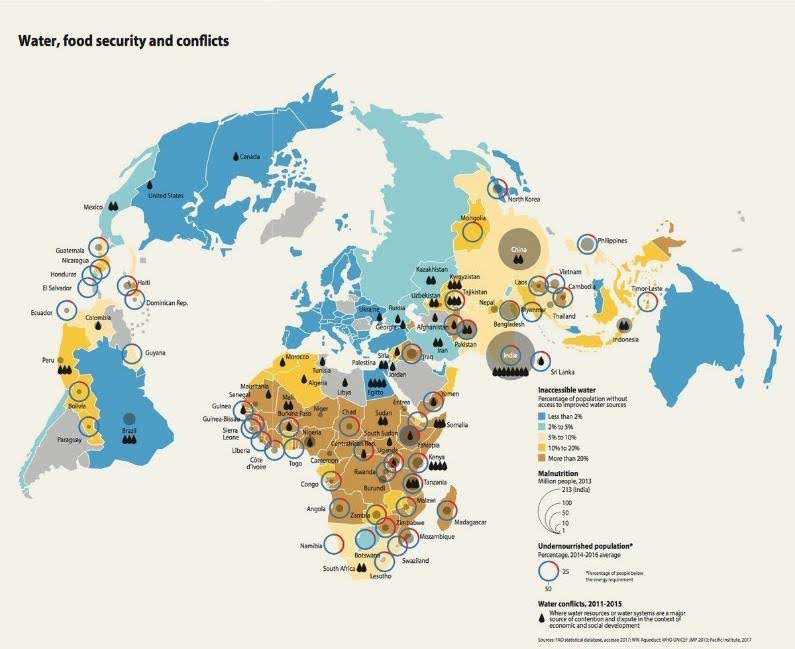
Image source: WaFS chart (waterandfoodsecurity.org).
Dublin Treaty on water and sustainable development: side effects
Mankind has always been concerned about water resource management, and the search for effective ways to do so has been and is a driving force in the development of human cognitive and pragmatic skills. With the advent of a globalised and interconnected world, but also due to a gradual decrease in the resource, the need to regulate its access at the international level arose as early as 30 years ago. For this reason, the first United Nations conference on water and sustainable development was held in Dublin in 1992, the outcome of which were 6 guiding principles that all participants were asked to follow.
We now come to the subject of the article, which is the practice of water grabbing (or: ”water appropriation”). Point number 4 of the Dublin Treaty for the first time assigns an economic value to water with the intention of reducing its wastage; however, as the availability of the resource decreases on a global scale, many states and individuals have taken advantage of this innovation to purchase water resources from other countries in the Global South – that is, with low economic availability -, especially from the Democratic Republic of Congo, Mali, Sudan and the Philippines where the percentage of water ”embezzled” exceeds 30 percent.
The practice of water grabbing, then, citing the water grabbing observatory refers to:
“Situations in which powerful actors are able to take control of or divert valuable water resources to their own advantage, taking them from local communities or entire nations: water is turned into a private good or controlled by those in power for which one must negotiate and be willing to pay. Thus, water grabbing represents one of the most widespread processes of human and social rights violation, appropriation and impoverishment of water and natural resources.”
The social and environmental impact
The buying and selling of the resource – which frequently takes place in a non-transparent manner – threatens the food security of many communities. In fact, agreements between states often protect only those closest to where there will be a drawdown from the source, leaving out those who, though farther away, are equally dependent on it. In addition, grabbed countries sometimes have inefficient water collection systems, with many leaks that further reduce the amount of water going to the population.
In Mali and Sudan, for example, where 20% of the available resource is not accessible, the government ‘sells’ water by measuring the amount of land to be irrigated rather than the cubic metres of water used for that purpose. In this way, local agricultural economies, already disadvantaged by increasingly frequent droughts, are put further at risk, as is the food supply of the communities that depend on them.
From the environmental point of view, water grabbing is many times accompanied by another kind of abuse, that of land appropriation, called ‘land grabbing‘. The plots involved are used for the planting of monocultures, which, together with the systems of water diversion from the source, have an enormous burden on the stability of ecosystems and their biodiversity. These types of plantations also drastically deplete the fertility and resilience of soils, making them more vulnerable to increasingly frequent extreme weather events.

Ph.: polyp.org.uk
Environmental justice, so far only a mirage
World Bank data to date report 507 cases worldwide of tensions over water use that have not been resolved through negotiation, and unfortunately the figure is set to rise.
Where to put hope if even international conventions end up having side effects that undermine both people’s food security and the integrity of ecosystems?
Having large supplies of labour and raw materials, countries in the Global South, i.e., those with lower incomes, are gaining more centrality in international politics, which allows them to have more weight in decision-making. The hope is that they can use this new geopolitical importance to break away from Western neo-colonialism and achieve independence worthy of the name.
The nationalisation of resources that has taken place in many countries is a step in this direction. Indeed, we can find in states such as Indonesia, Bolivia, and Ghana (which fortunately are not the only ones) virtuous examples against water privatisation. It is to be hoped, therefore, that other countries can seize in this new economic role the opportunity to redeem their peoples who have been oppressed for too long.
At the same time there is a need for international action to heal the legislative gaps that make water grabbing possible and ensure greater environmental justice for every living species.
Reading suggestions:
Pompan E., Iannelli M., Water Grabbing, le guerre nascoste per l’acqua nel XXI secolo, Emi, Bologna 2018.
The figure – known as virtual water – is provided by calculating for each nation the total volume of water per capita consumed to produce common products such as cars, T-shirts, plastic bottles and food. The total volume is therefore the product of water directed to domestic use and that used in the international market for the production of goods. The water footprint therefore varies from nation to nation in accordance with different climates and lifestyles.

Graduated in Modern Literature (UniVe), she is continuing her studies with a master’s degree in Environmental Humanities. Close to environmental and geopolitical issues, she finds in Atmosphera Lab, with which she is pleased to collaborate, an opportunity to deepen and share issues dear to her heart.
More articles