[Graphic work by Andrea Seganfreddo https://aseganfreddo.carrd.co/]
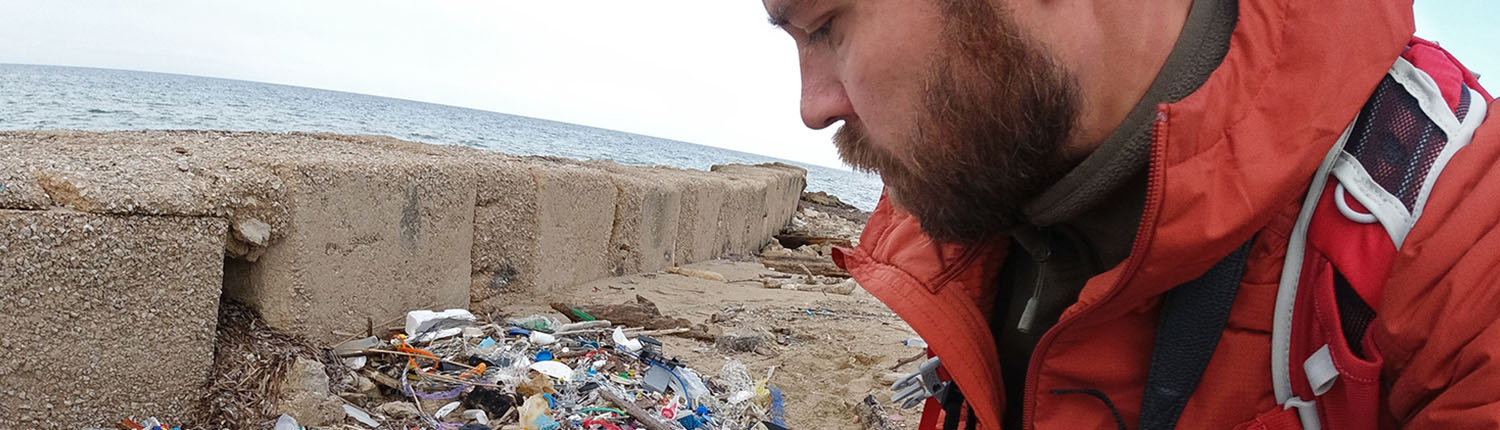
Plastics decompose very slowly in the environment, posing a serious danger to various natural ecosystems, especially marine ecosystems. According to the U.S. Environmental Protection Agency, about 34 million tons of plastics leaked into aquatic environments in 2020 alone. This phenomenon was renamed by Chinese environmental movements in the 1990s as “white pollution“. It consists of the dispersion of plastic debris into land and sea environments, and is responsible for various negative effects on them, such as those on marine habitats.
This pollution also has a strong impact on people and the environment as a whole. Recently, studies have been conducted on the harmful effects of microplastics in water and food that we ingest daily without realizing it, which can increase the risk of inflammation. As for the overall impact, the problem is not only about the pollution caused by plastics as a finished product, but also the pollution generated along the entire production chain. Indeed, most plastics are produced using synthetic materials derived from petroleum, with an environmental impact associated with the burning of fossil carbon.
Recycling is not enough
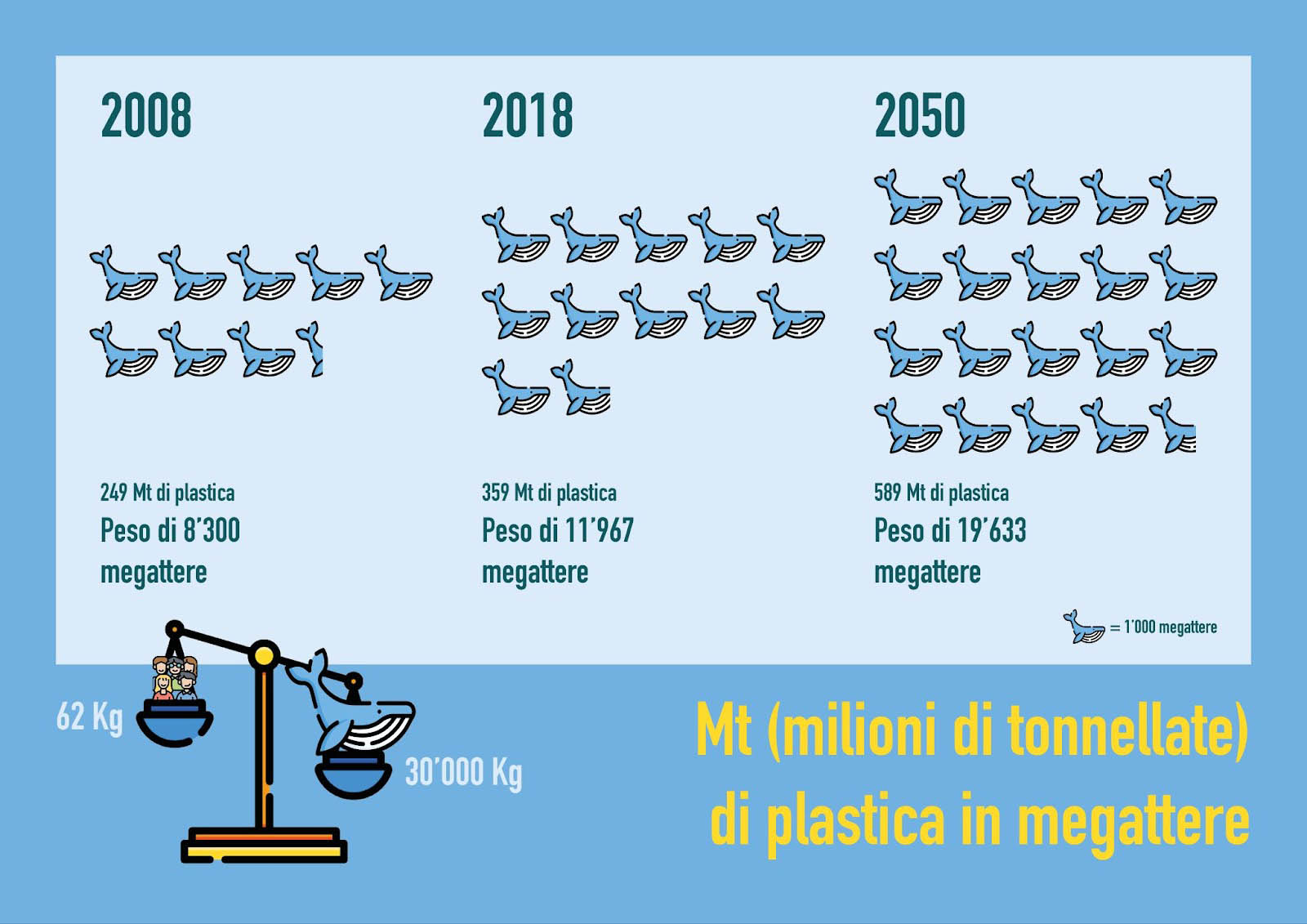
The problem is further complicated, as highlighted in our infographic, by the growing demand for plastics, mainly due to the increasing global population. With the general improvement in living conditions, more and more people have the economic opportunity to invest in product packaging. The properties of plastic, such as its strength and durability, combined with its low cost of production, make it the most cost-effective material for this purpose. These combined factors contribute to the growth in demand and production of plastics.
The sector most responsible for this is packaging. It occupies 40% of the total share, followed by the building and construction sector (20%), automotive (10%), electronics (6%), and sports and home appliances (4%).
Unfortunately, of the large amount of plastic produced, only a small percentage can be recycled. In 2019, it was estimated that only 9% of all plastic production was successfully recycled. In a recent article published in the Arabian Journal for Science and Engineering, researcher Yukta Arora, with her colleagues from the School of Bioengineering and Biosciences at Phagwara University, India, highlighted several factors that contribute to this figure: the high cost of disposal, the loss of plastic material properties, the lack of infrastructure for disposal and separation of plastic waste, and the lack of attention paid to recycling. Therefore, recycling alone is not a sufficient strategy to address the negative environmental impacts of plastic production.
The situation is critical: on the one hand, the demand for and production of plastics for packaging increases with negative environmental effects, and on the other hand, recycling is not a sufficiently cost-effective and effective method to counter these negative effects. What can we do about it? One possible solution comes from the sea: bioplastics derived from algae.
Bioplastics from algae
Since the late 19th century, several bioplastics have been studied and developed. Most of these solutions were based on the use of agri-food resources of plant origin, such as corn waste, parsley, spinach stalks, rice husks, etc. These products, although designed to solve the problem of synthetic plastics, also have limitations, such as the environmental impact from the production of the raw materials used, which require significant amounts of water.
The new alternative to both old generation bioplastics and synthetic plastics are bioplastics produced from algae. The advantages of using algae instead of petroleum as a raw material are many. Their production requires no additional nutrients, they capture carbon dioxide, and they are able to grow in large quantities in hostile environments, at high as well as low temperatures. In addition, invasive species of algae can be harvested and used for plastic production. Due to these properties, the production of bioplastics from algae has entered the focus of European funding projects such as the EU Blue Economy strategy, part of the Green Deal and Recovery Plan started in 2022.
One application of algae-derived bioplastics is in the packaging industry. In recent years, in addition to laboratory research, a number of start-ups and companies are emerging that apply this technology to develop innovative products aimed at meeting the demand for plastics with more sustainable and less environmentally impactful products.
A virtuous example of these new companies is Notpla. Founded in 2014 by Rodrigo Garcia Gonzalez and Pierre Paslier, then students of design and architecture at Imperial College London, it was born with the intention of finding innovative solutions to combat single-use plastics of synthetic origin. The interdisciplinary team developed the material Notpla, hence the company’s name, a derivative of brown algae. These algae, growing up to one meter per day without the need for fresh water or fertilizer, are particularly suitable for large-scale production. The advantage of this material, in addition to the low environmental impact of the production chain, is precisely the speed with which it disperses into the environment. Notpla, in fact, naturally biodegrades in about 4-6 weeks.
An example of Notpla‘s products is Ooho, a liquid container designed for a variety of applications: single-serve water container for sports, sauce container for table service in restaurants. Please note, it is not ingestible, but is designed to be put in the mouth in one gulp, and then tossed in the organic, like a fruit peel.
A way out: more bioplastics
Global demand for plastics will steadily increase in the coming years, and recycling is not enough to reduce the environmental impact of plastic dispersion and production for packaging. To solve the problem, one cannot hope that demand for plastics will decrease; instead, more sustainable products, such as bioplastics derived from algae, must be offered. Start-ups such as Notpla are working in this direction. It sounds like a paradox, but to solve the plastic problem, we need more plastic; bioplastics.

After graduating with a Master’s degree in Philosophy from the University of Padua, he attended a Master’s degree in Science Communication at the University of Trento. He currently works as a science communicator for foundations and research centres in Italy. He collaborates as a writer for Atmosphera Lab.
More articles